The principles and practice of modern surgery / by Roswell Park ... with 722 engravings and 60 full-page plates in colors and monochrome.
- Roswell Park
- Date:
- 1907
Licence: Public Domain Mark
Credit: The principles and practice of modern surgery / by Roswell Park ... with 722 engravings and 60 full-page plates in colors and monochrome. Source: Wellcome Collection.
Provider: This material has been provided by the Augustus C. Long Health Sciences Library at Columbia University and Columbia University Libraries/Information Services, through the Medical Heritage Library. The original may be consulted at the the Augustus C. Long Health Sciences Library at Columbia University and Columbia University.
1164/1200
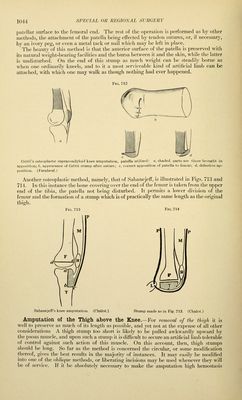
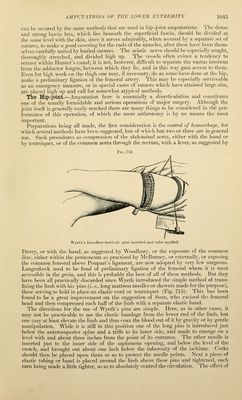
![tills is felt u])()n [)ractk'ally every vessel in that part of the body, and if the inetli(jd be properly praetised it affords absolute security. The suri^eon now has his choice of various methods of disarticulation, either that by antero})osterior flaps or lati'ral flaps, or by the circular, with the free liljcratino; lateral incision; or he may devise any method of his own which will Ix^st meet the indication in a o'iven case. Fig. 715 illustrates the employment of Wyeth's pins and the first circular incision made as for the circular method. Of these all the latter seems preferable when circumstances permit. It should be combined with a sufficient lateral incision, which should be made to pass well over the great trochanter. The cuff' raised through this incision should extend down to the deep fascia and up to the level of the lesser trochanter, at which level the deeper tissues are divided transversely or by a circular cut. It is well next to lay down the knife and secure the large vessels, after which the deep muscles are se])arated from the u|)per end of the shaft and the proximity of the jcnnt, while the entire limb may be still used as a lever in so stretching the joint capsule as to better expose and divide it. So soon as the capsule has been opened, and the entrance of air thus permitted, it will be easy to expose and divide the teres ligament, after which the balance of the disarticulation is easily effected. The large nerve trunks are now sought, retracted, and divided high up, all visible vessels are secured firmly, after which the elastic constriction may be gradually released and any vessels that spurt may still be secured. There will nearly always be trouf)lesome oozing from the cut ends of the large muscles, and here, if hot water prove insufficient to check it, with large curved needles and catgut sutures the muscle ends may be secured by ligature en masse, before they are brought together for the purp<jse (jf closing the stump. Whatever the method selected as jierfect a closure of the wound as possible should be made, with ample provision for drainage. By careful deep suturing, with tiers of buried sutures, it is possible to avoid leaving dead spaces at any point except perhaps the acetab- ulum. Through retaining sutures may also be used to advantage. It is most desirable to so plan the incisions and the closure of the wound as to keep them, so far as possible, away from the region of the perineum. Therefore the longer the inner flap or inside of the stum]) the better. As conditions which necessitate removal of the limb at the hip- joint are always serious, and have each their own peculiarities, any method which will best serve the jnirpose should be used. Plates LIX and LX, designed by Prof. JNIatas, afford the best and briefest epitome of the choicest amputation methods which can be furnished. THE STUMP. An amputation having been effected, and the stump closed, there is still occasion to consider how it may best be treated to fit it for its future pur))oses. When entire chapters, or even small monographs, can be written on the subject of diseases of stumps it would a])])ear that the consideration is not one of merely trifling import. A (jood stump has a regular outline, with a protected scar, and should be firm, yet mobile, and without tender or sensitive surfaces. It should constitute the lower end of a trun- cated cone, and needs to be of sufficient length to permit leverage within the socket of the artificial limb which will be fitted about it. A stump failing in these characteristics is a had stumj), the features which especially tend to make it bad being undue conicity (Fig. 716) or sensitiveness of surfaces, ulcera- tion from friction, or, worse yet, occurring without it, and neuralgia from inclusion of nerve ends, or from bone ends which present osteophytic outgrowths and thus distort and displace tissues (Fig. 717). Acute osteomyelitis occurs in stumps, as do slower carious processes which may call for re-amputation, jjerhaps even at a distance. The stump is for a long time more or less tender and troublesome, and its owner may be a sufferer from hyjieresthesia or perverted sensations. The possibility of the production of a conical stump in children as the result of atrophic elongation, was mentioned early in this chapter. While this cannot always be prevented it may sometimes be foreseen, and one should be prepared at any time in such cases to circumcise the bone, forcibly retract the tissues, and then divide the bone ends on a higher level. An exquisitely neuralgic stump is usually made so by the entanglement of nerve ends](https://iiif.wellcomecollection.org/image/b21211176_1164.jp2/full/800%2C/0/default.jpg)