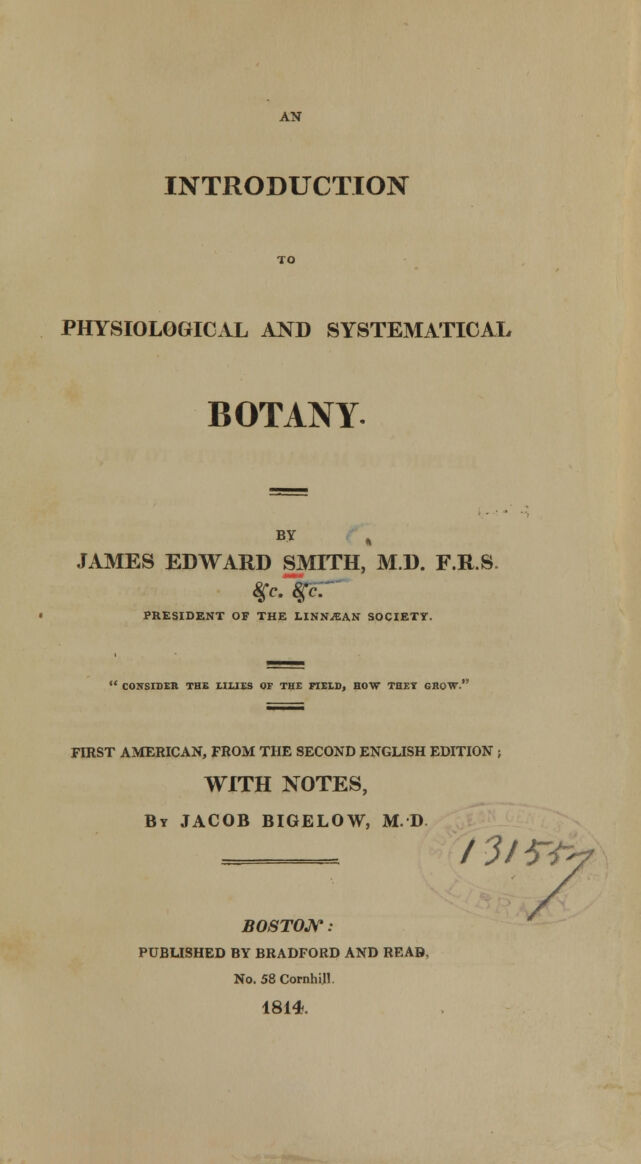
An introduction to physiological and systematical botany / by James Edward Smith.
- James Edward Smith
- Date:
- 1814
Licence: Public Domain Mark
Credit: An introduction to physiological and systematical botany / by James Edward Smith. Source: Wellcome Collection.
Provider: This material has been provided by the National Library of Medicine (U.S.), through the Medical Heritage Library. The original may be consulted at the National Library of Medicine (U.S.)
76/454
![W RP.S1N0T S SECRETIONS. Bot. t. 1581, and some plants allied to it, the emulsioa is orange-coloured.(7) The more refined and volatile secretions of a resinous nature are called Essential Oils, and are often highly aromatic and odoriferous. One of the most exquisite of these is afforded by the Cinnamon bark. They exist in the highest perfection in the perfumed effluvia of flowers, some of which, capable of combination, with spirituous fluids, are obtainable by distillation, as that of the Lavender and Rose ; while the essential oil of the Jasmine is best procured by immersing the flowers in expressed oil which imbibes and retains their fra- grance. Such Expressed or Gross Oils, as they are called, to distinguish them from essential oils obtained by distillation, are chiefly found in the seeds of plants. In the pulp of the Oiive indeed they occur in the form of an emulsion, mixed with watery and bitter fluids, from which the oil easily separates by its superior lightness. These expressed oils are not soluble in spirits or water, (7) rThe resinous juice, known in the northern states hy the name of Fir balsam* is a spontaneous exudation from the Pinus Halsamra, retained in little sacs or vesicles upon the bark. Turpentine is obtained in great quantities from ihe North American Pines, paiticularly Pinus Paluntris, by incisions or excavations in the trunk. When Turpentine is distilled, the Oil of Turpentine comes over, and Resin remains behind. Tar is obtained from the resinous trees by a slow combustion of their wood. Wax is a vegetable product. It exists on the surface of leaves, and probably in the pollen of flowers. It is obtained in large quantities from the berries of Myrica Crrifrra, Bayberry bus!), or Wax Myrtle ; by boiling the berries in water until the •wax melts and floats upon the surface.]](https://iiif.wellcomecollection.org/image/b21155082_0076.jp2/full/800%2C/0/default.jpg)