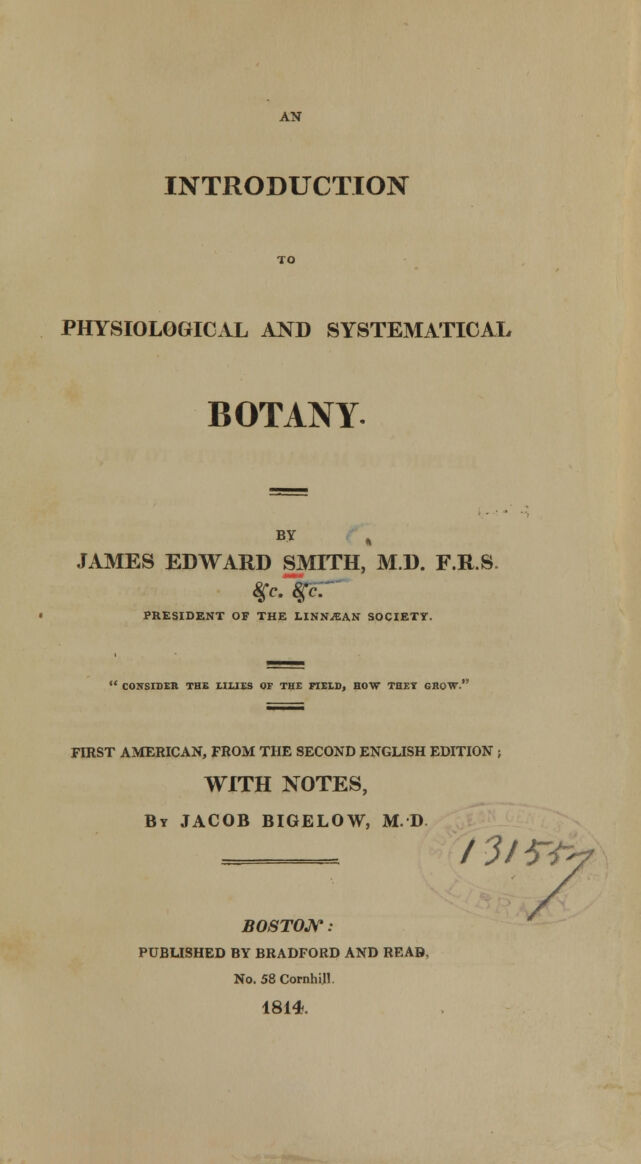
An introduction to physiological and systematical botany / by James Edward Smith.
- James Edward Smith
- Date:
- 1814
Licence: Public Domain Mark
Credit: An introduction to physiological and systematical botany / by James Edward Smith. Source: Wellcome Collection.
Provider: This material has been provided by the National Library of Medicine (U.S.), through the Medical Heritage Library. The original may be consulted at the National Library of Medicine (U.S.)
90/454
![&* FORCING OF PLANTS- same appearance ; which is exemplified every autumn in the Garden Nasturtium, Tropcsolum majus. The vegetables of cold climates, on the contrary, support a much greater degree of cold without injury, at least while in a torpid state ; for when their buds begin to expand they become vastly more sensible, as is but too frequently experienced in the fickle spring of our climate. Nor is this owing, as vulgarly supposed, merely to the greater power of the cold to penetrate through their opening buds. It must penetrate equally through them in the course of long and severe winter frosts, which are never known to injure them. The extremely pernicious effects therefore of cold on open- ing buds can only be attributed to the increased suscep- tibility of the vital principle, after it has been revived by the warmth of spring. The vegetation of most plants may be accelerated by artificial heat, which is called foreing them, and others may, by the same means, be kept in tolerable health, ground near a volcano as hot as 210°, and at the same time cov- ered with flowers. See Willdenow's Principles of Botany. In a similar manner the plants of high latitudes are capable of withstanding intense and long continued cold. Acerbi, in his travels in Sweden and Lapland, found Pines, Firs, and Birches from Tornea almost to the North Cape. Mackenzie, in latitude about 69,near the Frozen ocean, found the ground in July cover- ed with short grass and flowers, though the earth was not thaw- ed above four inches from the surface, beneath which was a solid body of ice. In the island of Spitzbergcn, there grow not less than thirty species of plants. In these climates, vegetation is exceedingly rapid during the few months which permit it-]](https://iiif.wellcomecollection.org/image/b21155082_0090.jp2/full/800%2C/0/default.jpg)