Volume 1
Natural history of Victoria : prodromus of the zoology of Victoria; or figures and descriptions of the living species of all classes of the Victorian indigenous animals / by Frederick McCoy.
- Frederick McCoy
- Date:
- [1885-90]
Licence: Public Domain Mark
Credit: Natural history of Victoria : prodromus of the zoology of Victoria; or figures and descriptions of the living species of all classes of the Victorian indigenous animals / by Frederick McCoy. Source: Wellcome Collection.
Provider: This material has been provided by Royal College of Physicians, London. The original may be consulted at Royal College of Physicians, London.
37/630
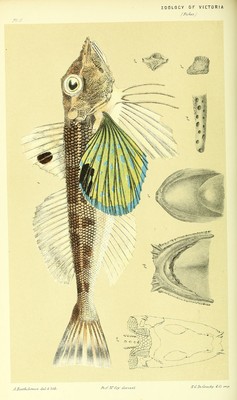
![Plate 4. CHRYSOPHRYS AUSTRALIS (Gunth.). The Australian Bream. [Genus CHRYSOPHRYS (Cuv.). (Sub-kingd. Vertebrata. Class Pisces. Order Acanthop- terygia. Pam. Sparidse.) Gen. Char.—Four or six conical teeth in front edge of the mouth, and three or more rows of rounded, nearly hemispherical, crushing teeth in upper and lower jaws. Cheeks scaly. The dorsal fin with about eleven or twelve spines, fitting into a deep channel along the insertion of their bases. Anal fin, with the three anterior rays spinous, very strong. Scales moderately large. Six branchyostegal rays. Air-bladder usually notched or lobed. Extends from Atlantic coast of America to Europe and Africa, the Indian Ocean and Pacific.] Description.—Fin-rays: dorsal, 11 spinous, fourth longest, and 11 branched, the two last united at base; anal, 3 spinous, first very short, second longest, and 9 branched (two last united at base); ventral, 1 spinous, 5 branched; pectoral, 14; caudal, 18. Scales: lateral line, 55 to 58, 5 rows above and 17 below the lateral line; 5 rows of scales on cheek to angle of preoperculum, 6 rows to angle of operculum from edge of preoperculum. Pro-portions : body ovate, compressed ; head small, profile arching gradually from origin of dorsals to tip of snout with slight convexity, and tapering from same vertical of greatest depth gradually to the tail; usual length (of specimen from Gippsland), 121? inches to end of caudal fin; greatest depth at base of fourth dorsal fin-ray, 4-| inches; thickness, If inches; length of head, 3 inches 1 line; diameter of eye 8 lines (about 4§ in length of head); greatest height of dorsal fin, at fourth spine, 1 inch 4 lines, equal to length from anterior edge of orbit to end of snout; length of third spine, 1 inch 3 lines; length of second, 10 lines; of first, 5 fines; length of pectoral fin, 3 inches 11 fines; first anal spine, 3 fines; second longest, equalling the fourth dorsal. Teeth: there are 6 large conical teeth projecting in front of the upper jaw, and 6 slightly smaller below; the outer lateral row above and below more conical than the inner rows, which are hemispherical, about 3 rows below and about 4 rows above, the inner and posterior teeth largest below, the third row largest above. Color: the scales of the cheeks, back, and sides, are each minutely dotted with black points on a changing ground of beautifully lustrous green and gold bronze, with occasional bright-blue and copper-red reflections fading into purple, the reddish and blue being predominantly on the cheeks, and the purple on the top of the head; the scales of the belly are of a yellowish pearly-white; there are faint longitudinal streaks of purple or gold, darker or brighter according to the fight, extending from head to tail through about the middle third of each scale of the longitudinal lateral rows ; dorsal fin yellowish behind, the membrane clouded and freckled with purplish, the margin darker, the spines minutely dotted with brown; anal fin yellowish behind, anterior two-thirds purplish-grey clouded with dark; ventral fins, rays yellowish, minutely freckled with darker, membrane nearly colorless; pectoral fin, rays brownish, membrane nearly colorless; caudal fin, yellowish-olive, with a blackish terminal margin; iris of a gold bronze, with a narrow orange line, and freckled with minute black dots. Reference.—Gunther, Cat. Acanthop. Fishes, vol. 1, p. 494. [ 15 ]](https://iiif.wellcomecollection.org/image/b24757469_0001_0037.jp2/full/800%2C/0/default.jpg)




 No text description is available for this image
 No text description is available for this image
 No text description is available for this image