Volume 1
Natural history of Victoria : prodromus of the zoology of Victoria; or figures and descriptions of the living species of all classes of the Victorian indigenous animals / by Frederick McCoy.
- Frederick McCoy
- Date:
- [1885-90]
Licence: Public Domain Mark
Credit: Natural history of Victoria : prodromus of the zoology of Victoria; or figures and descriptions of the living species of all classes of the Victorian indigenous animals / by Frederick McCoy. Source: Wellcome Collection.
Provider: This material has been provided by Royal College of Physicians, London. The original may be consulted at Royal College of Physicians, London.
497/630
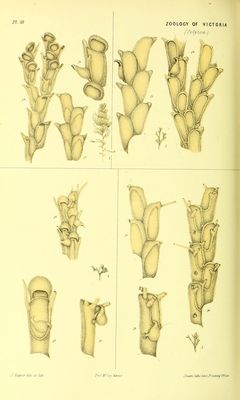
![Plate 78, Fig. 4. BUGULA AVICULARIA (Pall.). Description.—Cells biserial, elongated, small; two spines at the upper and outer angle, and one at the inner; aperture occupying the greater part of the anterior surface; avicularia small, capitate, situated on the outer side, close to the margin of the aperture, and at about its middle; ovicell surmounting a cell, rounded, rather contracted below. Reference.—Busk, Brit. Mus. Cat., Mar. Polyzoa, p. 45, pi. liii. Hobson’s Bay, on piles and hulks. There can, I think, be no doubt of the identity of this with the well-known European species. It may be distinguished by the small size of the cells, the number and form of the spines, the shape of the ovicells, and the situation of the avicularia. Explanation op Figukes. Fig. 4, fragment, natural size. Fig. 4a, front view of portion, magnified. Fig. 4b, single-cell, showing ovicell and avicularium, more highly magnified. Fig. 4c, side view of cell. I am indebted to Dr. MacGillivray for the typical specimens and descriptions of the species of Bugula on this plate. Frederick McCoy. 13i ]](https://iiif.wellcomecollection.org/image/b24757469_0001_0497.jp2/full/800%2C/0/default.jpg)