Volume 1
Natural history of Victoria : prodromus of the zoology of Victoria; or figures and descriptions of the living species of all classes of the Victorian indigenous animals / by Frederick McCoy.
- Frederick McCoy
- Date:
- [1885-90]
Licence: Public Domain Mark
Credit: Natural history of Victoria : prodromus of the zoology of Victoria; or figures and descriptions of the living species of all classes of the Victorian indigenous animals / by Frederick McCoy. Source: Wellcome Collection.
Provider: This material has been provided by Royal College of Physicians, London. The original may be consulted at Royal College of Physicians, London.
521/630
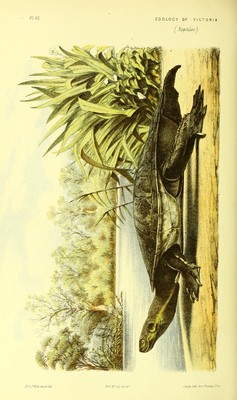
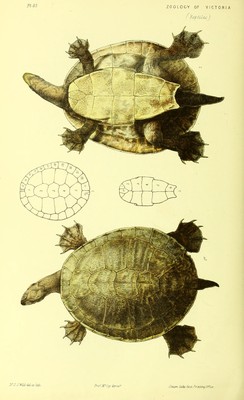
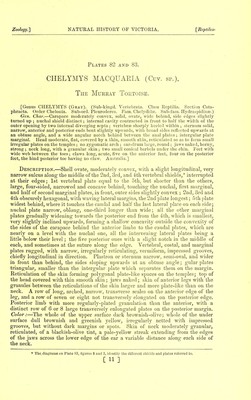
![Plates 82 and 83. CHELYMYS MACQUAKIA (Cuv. sp.). The Murray Tortoise. [Genus CHELYMYS (Gray). (Sub-kingd. Vertebrata. Class Reptilia. Section Cata- phracta. Order Chelonia. Sub-ord. Pleuroderes. Pam. Chelydidae. Sub-fam. Hydraspidinae.) Gen. Char.—Carapace moderately convex, solid, ovate, wide behind, side edges slightly turned up ; nuchal shield distinct; internal cavity contracted in front to half the width of the outer opening by two internal diverging septa; vertebrae sharply keeled within ; sternum solid, narrow, anterior and posterior ends bent slightly upwards, with broad sides reflected upwards at an obtuse angle, and a wide angular notch behind between the anal plates; intergular plate marginal. Head moderate, flat, covered by a thin, smooth skin, reticulated so as to form small irregular plates on the temples ; no zygomatic arch ; ear-drum large, round; jaws naked, horny, strong ; neck long, with a granular skin ; two small conical barbels under the chin. Peet with wide web between the toes; claws long, acute, five on the anterior feet, four on the posterior feet, the hind posterior toe having no claw. Australia.] Description.—Shell ovate, moderately convex, with a slight longitudinal, very narrow sulcus along the middle of the 2nd, 3rd, and 4th vertebral shields,* interrupted at their edges; 1st vertebral plate equal to the 5th, but shorter than the others, large, four-sided, narrowed and concave behind, touching the nuchal, first marginal, and balf of second marginal plates, in front, outer sides slightly convex ; 2nd, 3rd and 4th obscurely hexagonal, with waving lateral margins, the 2nd plate longest; 5th plate widest behind, where it touches the caudal and half the last lateral plate on each side; nuchal plate narrow, oblong, one-third longer than wide; all the other marginal plates gradually widening towards the posterior end from the 4th, which is smallest, very slightly inclined upwards, forming a shallow concavity outside the convexity of the sides of the carapace behind the anterior limbs to the caudal plates, which are nearly on a level with the nuchal one, all the intervening lateral plates being a little below their level; the five posterior ones with a slight notch in the middle of each, and sometimes at the suture along the edge. Vertebral, costal, and marginal plates rugged, with narrow, irregularly reticulating, vermiform, impressed grooves, chiefly longitudinal in direction. Plastron or sternum narrow, semi-oval, and wider in front than behind, the sides sloping upwards at an obtuse angle; gular plates triangular, smaller than the intergular plate which separates them on the margin. Reticulation of the skin forming polygonal plate-like spaces on the temples; top of the head covered with thin smooth skin; jaws naked; skin of anterior legs with the granules between the reticulations of the skin larger and more plate-like than on the neck. A row of long, arched, narrow, transverse scales on the anterior edge of the leg’, and a row of seven or eight not transversely elongated on the posterior edge. Posterior limb with more regularly-plated granulation than the anterior, with a distinct row of 6 or 8 large transversely enlongated plates on the posterior margin. Color:—The whole of the upper surface dark brownish-olive; whole of the under surface dull brownish and greenish yellow, irregularly netted with impressed grooves, but without dark margins or spots. Skin of neck moderately granular, reticulated, of a blackish-olive tint, a pale-yellow streak extending- from the edges of the jaws across the lower edge of the ear a variable distance along each side of the neck. * The diagrams on Plate 83, figures 2 and 3, identify the different shields and plates referred to.](https://iiif.wellcomecollection.org/image/b24757469_0001_0521.jp2/full/800%2C/0/default.jpg)