Volume 1
Natural history of Victoria : prodromus of the zoology of Victoria; or figures and descriptions of the living species of all classes of the Victorian indigenous animals / by Frederick McCoy.
- Frederick McCoy
- Date:
- [1885-90]
Licence: Public Domain Mark
Credit: Natural history of Victoria : prodromus of the zoology of Victoria; or figures and descriptions of the living species of all classes of the Victorian indigenous animals / by Frederick McCoy. Source: Wellcome Collection.
Provider: This material has been provided by Royal College of Physicians, London. The original may be consulted at Royal College of Physicians, London.
551/630
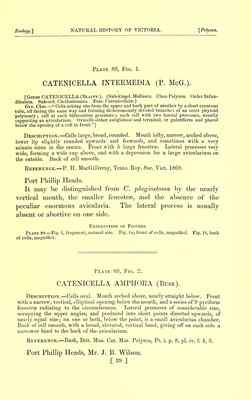
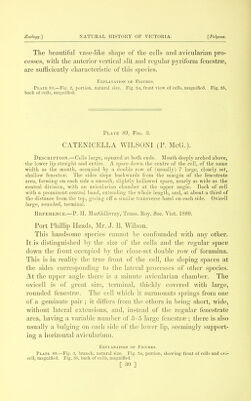
![Plate 89, Fig. 1. CATENICELLA INTERMEDIA (P. McG.). [Genus CATENICELLA (Blainv.). (Sub-kingd. Mollusca. Class Polyzoa. Order Infun- dibulata. Sub-ord. Cheilostomata. Earn. Catenicellidae.) Gen. Char.—“ Cells arising one from the upper and back part of another by a short corneous tube, all facing the same way and forming dichotomously divided branches of an erect phytoid polyzoary; cell at each bifurcation geminate ; each cell with two lateral processes, usually supporting an avicularium. Ovicells either subglobose and terminal, or galeriform and placed below the opening of a cell in front.”] Description.—Cells large, broad, rounded. Mouth lofty, narrow, arched above, lower lip slightly rounded upwards and forwards, and sometimes with a very minute sinus in the centre. Front with 5 large fenestra. Lateral processes very wide, forming a wide cup above, and with a depression for a large avicularium on the outside. Back of cell smooth. Reference.—P. H. MacGillivray, Trans. Roy. Soc. Viet. 1868. Port Phillip Heads. It may be distinguished from C. plagiostoma by the nearly vertical mouth, the smaller fenestra;, and the absence of the peculiar enormous avicularia. The lateral process is usually absent or abortive on one side. Explanation of Figures. Plate 89.—Fig. 1, fragment, natural size. Fig. la, front of cells, magnified. Fig. lb, back of cells, magnified. Plate 89, Fig. 2. CATENICELLA AMPHORA (Busk). Description.—Cells oval. Mouth arched above, nearly straight below. Front with a narrow, vertical, elliptical opening below the mouth, and a series of 9 pyriform fenestra radiating to the circumference. Lateral processes of considerable size, occupying the upper angles, and produced into short points directed upwards, of nearly equal size; on one or both, below the point, is a small avicularian chamber. Back of cell smooth, with a broad, elevated, vertical band, giving off on each side a narrower band to the back of the avicularium. Reference.—Busk, Brit. Mus. Cat. Mar. Polyzoa, Pt. i. p. 8, pi. iv. f. 4, 5. Port Phillip Heads, Mr. J. B. Wilson.](https://iiif.wellcomecollection.org/image/b24757469_0001_0551.jp2/full/800%2C/0/default.jpg)