Volume 1
Natural history of Victoria : prodromus of the zoology of Victoria; or figures and descriptions of the living species of all classes of the Victorian indigenous animals / by Frederick McCoy.
- Frederick McCoy
- Date:
- [1885-90]
Licence: Public Domain Mark
Credit: Natural history of Victoria : prodromus of the zoology of Victoria; or figures and descriptions of the living species of all classes of the Victorian indigenous animals / by Frederick McCoy. Source: Wellcome Collection.
Provider: This material has been provided by Royal College of Physicians, London. The original may be consulted at Royal College of Physicians, London.
604/630
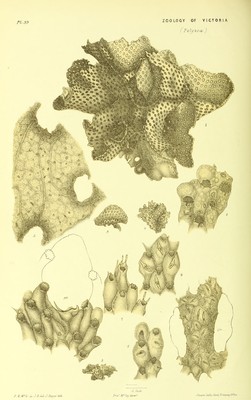
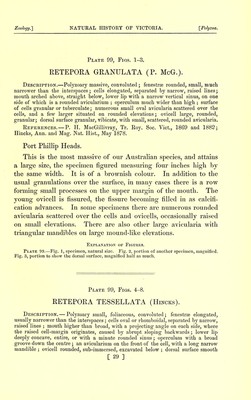
![Zoology.] NATURAL HISTORY OF VICTORIA. [Polyzoa. or minutely tubercular, divided by numerous raised lines into irregular spaces, in each of which is usually situated a long narrow avicularium similar to those on the front of the cells. Reference.—Hincks, Ann. and Mag. Nat. Hist., May 1878. Port Phillip Heads, 12-15 fathoms. The best specimens I have of this species are of small size, one measuring 1 by f inch, and another § by f. The fenestrse are large, much elongated, usually rather narrower than the interspaces. The cells are oval or irregularly rhomboidal ; they are separated by narrow raised lines which unite with the slightly thickened lateral margins of the mouth at about the middle, forming a con- spicuous angle on each side. The mouth is higher than wide, the lower lip hollowed, slightly thickened, entire, or with a small rounded sinus. Immediately above the junction of the separating lines of the cells the mouth recedes, and the angle here formed frequently gives rise to a jointed spine. In young, growing cells the mouth is nearly round, with a fringe-like upper edge to which are articulated several long, slender spines. A similar border and spines are also frequently present in the marginal cells of older parts. On the front of the cell is an avicularium, frequently situated on an eminence, with a long pointed mandible directed transversely, obliquely, or vertically downwards. The ovicell is rounded, deeply notched below. This notch, however, is probably ultimately filled in. The back of the polyzoary is mapped out into irregular areas by narrow raised vibices, in each of which is one or occasionally two avicularia similar to those found on the front of the cells. The operculum is very peculiar. It is of small size, rounded above ; there is an inner mark, parallel to the free margin except that at about the middle on each side it is sharply inflected inwards ; down the centre is a wide groove, on each side of which, especially towards the base, the surface bulges forwards. Explanation of Figures. Plate 99.—Figs. 4 and 5, specimens, natural size. Fig. 6, group of cells, magnified. Fig. 6a, dorsal surface, showing the small areas, with narrow avicularia. Fig. 7, young cells, magnified. Fig. 8, small group, showing an ovicell.](https://iiif.wellcomecollection.org/image/b24757469_0001_0604.jp2/full/800%2C/0/default.jpg)