Volume 1
Natural history of Victoria : prodromus of the zoology of Victoria; or figures and descriptions of the living species of all classes of the Victorian indigenous animals / by Frederick McCoy.
- Frederick McCoy
- Date:
- [1885-90]
Licence: Public Domain Mark
Credit: Natural history of Victoria : prodromus of the zoology of Victoria; or figures and descriptions of the living species of all classes of the Victorian indigenous animals / by Frederick McCoy. Source: Wellcome Collection.
Provider: This material has been provided by Royal College of Physicians, London. The original may be consulted at Royal College of Physicians, London.
609/630
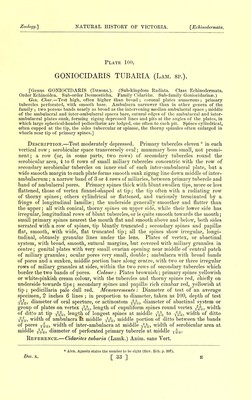
![Plate 100. GONIOCIDARIS TUB ARIA (Lam. sp.). [Genus GONIOCIDARIS (Desors.). (Sub-kingdom Radiata. Class Echinodermata. Order Echinoidea. Sub-order Desmosticha. Family Cidaridae. Sub-family Goniocidarinse.) Gen. Char.—Test high, often higher than broad ; coronal plates numerous; primary tubercles perforated, with smooth base. Ambulacra narrower than in other genera of the family ; two porous bands nearly as broad as the intervening median ambulacral space ; middle of the ambulacral and inter-ambulacral spaces bare, sutural edges of the ambulacral and inter- ambulacral plates sunk, forming zigzag depressed lines and pits at the angles of the plates, in which large spherical-headed pedicellarise are lodged, one often to each pit. Spines cylindrical, often cupped at the tip, the sides tubercular or spinose, the thorny spinules often enlarged in whorls near tip of primary spines.] Description.—Test moderately depressed. Primary tubercles eleven* in each vertical row ; serobicular space transversely oval; mammary boss small, not promi- nent; a row (or, in some parts, two rows) of secondary tubercles round the serobicular area, 4 to 6 rows of small miliary tubercles concentric with the row of secondary serobicular tubercles on inner end of each inter-ambulacral plate, but a wide smooth margin to each plate forms smooth sunk zigzag line down middle of inter- ambulacrum ; a narrow band of 3 or 4 rows of miliaries, between primary tubercle and band of ambulacral pores. Primary spines thick with blunt swollen tips, more or less flattened, those of vertex funnel-shaped at tip; the tip often with a radiating row of thorny spines; others cylindrical or flattened, and variously terminated by a fringe of longitudinal lamillse; the underside generally smoother and flatter than the upper; all with conical, thorny spines on upper side, while their lower side has irregular, longitudinal rows of blunt tubercles, or is quite smooth towards the mouth; small primary spines nearest the mouth flat and smooth above and below, both sides serrated with a row of spines, tip bluntly truncated ; secondary spines and papillae flat, smooth, with wide, flat truncated tip; all the spines show irregular, longi- tudinal, obtusely granular lines under the lens. Plates of vertex, or abactinal system, with broad, smooth, sutural margins, but covered with miliary granules in centre; genital plates with very small ovarian opening near middle of central patch of miliary granules; ocular pores very small, double; ambulacra with broad bands of pores and a sunken, middle portion bare along- centre, with two or three irregular rows of miliary granules at sides, within the two rows of secondary tubercles which border the two bands of pores. Colour: Plates brownish; primary spines yellowish or white-pinkish cream colour, with the tubercles and thorny spines red, chiefly on underside towards tips; secondary spines and papillae rich cinabar red, yellowish at tip ; pedicillaria pale dull red. Measurements: Diameter of test of an average specimen, 2 inches 6 lines ; in proportion to diameter, taken as 100, depth of test AV? diameter of oral aperture, or actinostom diameter of abactinal system or group of plates on vertex T^-, length of cupuliform spines round vertex width of ditto at tip , length of longest spines at middle x%Sq to T6^, width of ditto •^o, width of ambulacra St middle middle portion of ditto between the bands of pores xyy-jy, width of inter-ambulacra at middle -^g-, width of serobicular area at middle xg%, diameter of perforated primary tubercle at middle Reference.—Cidarites tubaria (Lamk.) Anim. sans Vert. s Alex. Agassiz states the number to be eight (Rev. Ech. p. 39T).](https://iiif.wellcomecollection.org/image/b24757469_0001_0609.jp2/full/800%2C/0/default.jpg)