Volume 1
Thesaurus logarithmorum completus. : Vollständige Sammlung grösserer logarithmisch-trigonometrischer Tafeln.
- Adriaan Vlacq
- Date:
- 1889
Licence: Public Domain Mark
Credit: Thesaurus logarithmorum completus. : Vollständige Sammlung grösserer logarithmisch-trigonometrischer Tafeln. Source: Wellcome Collection.
Provider: This material has been provided by London School of Hygiene & Tropical Medicine Library & Archives Service. The original may be consulted at London School of Hygiene & Tropical Medicine Library & Archives Service.
20/362 (page 4)
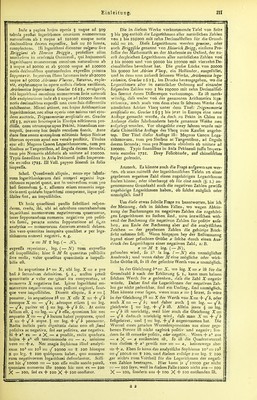
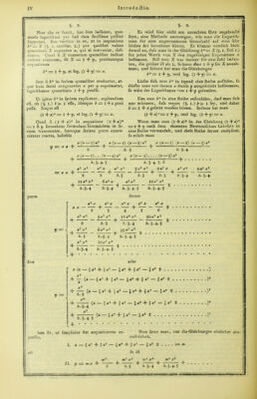
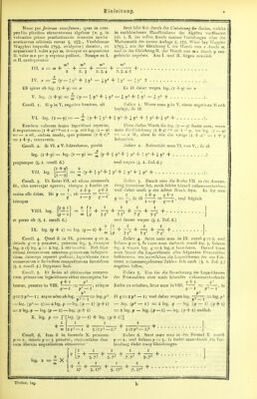
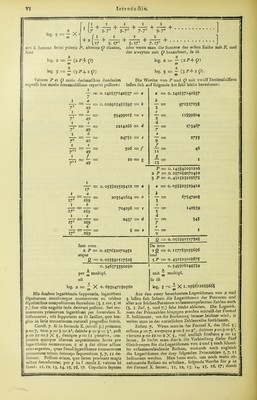
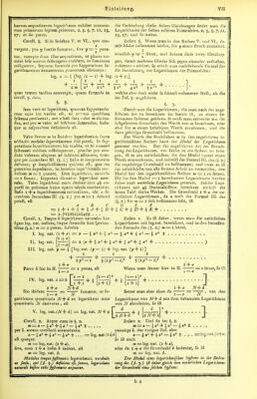
![§. 2. Nonf abs re fuerit, hoc loco indicare, quo- inodo logarithms pro bafi data facillirae poffint fupputari. Res vertitur in eo, tit in aequatione bx = X (§. I. corollar. I.) pro quolibet valore quantitatis X exponens x, qui ei conveniat, defi- niatur. Quod fi X numerum quemlibet indicat unitate majorem, fit X = I + y, prodeuntque aequationes b* = i + y, ct log. (i + y) — x. Jam fi b* in feriem quainlibet evoluatur, at- que huic ferici congruenter x per y exprimatur, logaritlimus quantitatis I 4- y prodit. Ut igitur b* in feriem explicetur, cogitandum eft, ob (§. I.) b > I effe, ideoque b — i+a poni polTe. Itaque eft (I + «)* = i + y, et log. (I + y) — x. Quod 11 (I + a)x in aequatione (l + a)x == I 4 y fecundum formulam binomialem in fe- riem transmutes, hancque feriem porro conve- nienter tractes, habebis Es wird bier nicht am unrechten Orle angebvacht feyn, eine Methode anzuzeigen, wie man die Lcgarith- men fur eine angenommene Grundzahl auf eine fehr leichte Art berechnen konne. Es kommt namlich blofs darauf an, daCs man in der Gleichung bx — X (§. I. Zuf. I.) fiir jeden Werth von X den zugehorigen Exponenten ,v beftimme. Soil nun X was immer fiir eine Zahl bedeu- ten, die grofser iff als I, fokann man I -{- y fiir X anneh- men; und fodann hat man die Gleichungen . b * = I + if, und log. (i+y)~ x. Liefse fich nun b* in irgend eine Reihe auflofen, fo diirfte man nur daraus x durch y ausgedriickt beftimmen, fo ware der Logarithmus von 1 -r y gefunden. Um nun b* in eine Reihe aufzulbfen, darf man fich nur erinnern, dafs wegen i.) ^> i fey, und daher i = I +f gefetzt werden konne. Sodann hat man (I + a)* — I + y, und log. (i + y) — x. Wenn man nun (i 4*f)K in der Gleichung (I 4**0* = I 4 y nach dein ekannten Newtonifchen Lelirfatz in eine Reihe verwandelt, und diefe Reihe ferner analyfiret, fo erhalt man x(x — l) a2 x (se- lf = x a + + ' I) (X — 2) a' 2. 3 (x— I) fx — 2) (x — 3)a< 2.3-4 x (x — i) . . . (x 4) fl 5 j x (x I) . 4- —■—'— 4- (x— S)'fl6 2. 3- 4- 5 .2 „2 2. 3 4-5-0 + a' x a' 4. 2 2.3 3rt] 2.3 + zay x 2. 3 + x 2.3.4 6«4 x3 2. 3.4 porro + + + 4- five H a* x* 6 a* x 2.3.4 2.3.4 a*x <l? X + 2 3 a2x* 3«? x* 2 2. 3 «3 X1 6a4 x* 2. 3 2,-3.4 fl4 X* IO a5 x* 2.3.4 2. 3. 4. 5 (a — I a2 + !«* - X7 i a7 A- T 2 « 3 a= x' 2.3-4-5 ferner IO<^ x* 2. 3. 4. 5 a* x + 4 II a* x2 2.3.4 as x + 5 2. 3.4. 5 + 2.3.4.5 oder 4- 5a« — Ja4 4- 1 «5 ~ S«6 ± 4- + 4- 4- 2.3 (« — I «4 4- i a? — I a* 4- I fl1 — 116 ± 2.,3.-4 O — I «2 4- -} <r» — i «* 4- -} fl5 — -2 a6 ± 4-5 4- I a* — ± )3 )5 Jam fit, ut limplicior fiat aequationum ex- Nun fetze man, um die Gleichungen emfacher aus- preffio, zudrucken, i a- + eft fo ift L 2-3 2.3.4](https://iiif.wellcomecollection.org/image/b2135702x_001_0020.jp2/full/800%2C/0/default.jpg)