Memoir of John Aubrey, F.R.S.; embracing his autobiographical sketches, a brief review of his personal and literary merits, and an account of his works, with extracts from his correspondence, anecdotes of some of his contemporaries, and of the times in which he lived / By John Britton ... Published by the Wiltshire Topographical Society [with its 5th Annual Report, 1845].
- John Britton
- Date:
- 1845
Licence: Public Domain Mark
Credit: Memoir of John Aubrey, F.R.S.; embracing his autobiographical sketches, a brief review of his personal and literary merits, and an account of his works, with extracts from his correspondence, anecdotes of some of his contemporaries, and of the times in which he lived / By John Britton ... Published by the Wiltshire Topographical Society [with its 5th Annual Report, 1845]. Source: Wellcome Collection.
54/158 page 32
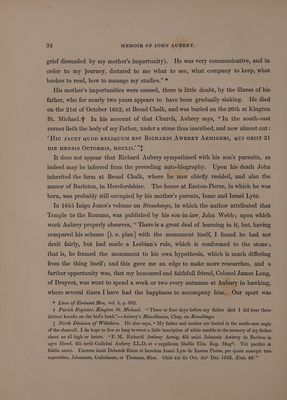
![grief dissuaded by my mother’s importunity).. He was very communicative, and in order to my journey, dictated to me what to see, what company to keep, what bookes to read, how to manage my studies.” * His mother’s importunities were caused, there is little doubt, by the illness of his father, who for nearly two years appears to have been gradually sinking. He died on the 21st of October 1652, at Broad Chalk, and was buried on the 26th at Kington St. Michael.}~ In his account of that Church, Aubrey says, “In the south-east corner lieth the body of my Father, under a stone thus inscribed, and now almost out: ‘Hic JACET QUOD RELIQUUM EST RICHARDI AWBREY ARMIGERI, QUI OBIIT 21 DIE MENSIS OcCTOBRIS, MDCLII.’ t It does not appear that Richard Aubrey sympathised with his son’s pursuits, as indeed may be inferred from the preceding auto-biography. Upon his death John inherited the farm at Broad Chalk, where he now chiefly resided, and also the manor of Burleton, in Herefordshire. The house at Easton-Pierse, in which he was born, was probably still occupied by his mother’s parents, Isaac and Israel Lyte. In 1655 Inigo Jones’s volume on Stonehenge, in which the author attributed that Temple to the Romans, was published by his son-in-law, John Webb; upon which work Aubrey properly observes, “ There is a great deal of learning in it, but, having compared his scheme [i. e. plan] with the monument itself, I found he had not dealt fairly, but had made a Lesbian’s rule, which is conformed to the stone; that is, he framed the monument to his own hypothesis, which is much differing from the thing itself; and this gave me an edge to make more researches, and a further opportunity was, that my honoured and faithfull friend, Colonel James Long, of Draycot, was wont to spend a week or two every autumne at Aubury in hawking, where several times I have had the happiness to accompany him, Our sport was * Lives of Eminent Men, vol. ii. p. 382. + Parish Register, Kington St. Michael. “Three or four days before my father died I did hear three distinct knocks on the bed’s head.”—Aubrey’s Miscellanies, Chap. on Knockings. $ North Division of Wiltshire. He also says, “ My father and mother are buried in the south-east angle of the chancell. I do hope to live so long to erect a little inscription of white marble to the memory of my father about an ell high or better. ‘P.M. Richardi Awbrey Armig. filii unici Johannis Awbrey de Burlton in agro Heref. filii tertii Gulielmi Awbrey LL.D. et e supplicum libellis Eliz. Reg. Mag. Viri pacifici & fidelis amici. Uxorem duxit Deborah filiam et heredem Isaaci Lyte de Easton Pierse, per quam suscepit tres superstites, Johannem, Gulielmum, et Thomam, filios. Obiit xxi die Oct. An® Dni. 1652, Etat. 49.’”](https://iiif.wellcomecollection.org/image/b33522169_0054.jp2/full/800%2C/0/default.jpg)