Breeding and the Mendelian discovery / by A.D. Darbishire.
- Arthur Dukinfield Darbishire
- Date:
- 1912
Licence: Attribution-NonCommercial 4.0 International (CC BY-NC 4.0)
Credit: Breeding and the Mendelian discovery / by A.D. Darbishire. Source: Wellcome Collection.
357/372 page 273
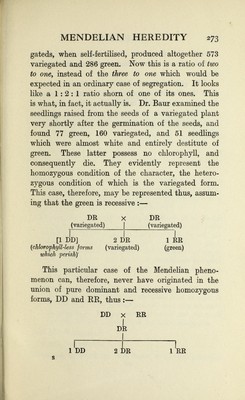
![MENDELIAN HEREDITY 273 gateds, when self-fertilised, produced altogether 573 variegated and 286 green. Now this is a ratio of two to one, instead of the three to one which would be expected in an ordinary case of segregation. It looks like a 1:2:1 ratio shorn of one of its ones. This is what, in fact, it actually is. Dr. Baur examined the seedlings raised from the seeds of a variegated plant very shortly after the germination of the seeds, and found 77 green, 160 variegated, and 51 seedlings which were almost white and entirely destitute of green. These latter possess no chlorophyll, and consequently die. They evidently represent the homozygous condition of the character, the hetero¬ zygous condition of which is the variegated form. This case, therefore, may be represented thus, assum¬ ing that the green is recessive :— DR X DR (variegated) | (variegated) ^ [1 IID] 2 DR 1 RR {cTilorophyU-less forms (variegated) (green) which perish) This particular case of the Mendelian pheno¬ menon can, therefore, never have originated in the union of pure dominant and recessive homozygous forms, DD and KR, thus DD X RR I DR 1 'DD 2 DR s 1 W](https://iiif.wellcomecollection.org/image/b18022911_0358.JP2/full/800%2C/0/default.jpg)