A defence of the system of solitary confinement of prisoners adopted by the state of Pennsylvania : with remarks on the origin, progress and extension of this species of prison discipline / by George W. Smith.
- George W. Smith
- Date:
- 1833
Licence: Public Domain Mark
Credit: A defence of the system of solitary confinement of prisoners adopted by the state of Pennsylvania : with remarks on the origin, progress and extension of this species of prison discipline / by George W. Smith. Source: Wellcome Collection.
74/104 page 74
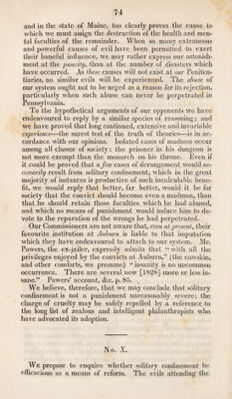
![and in the state of Maine, too clearly proves the cause to which we must assign the destruction of the health and men¬ tal faculties of the remainder. When so many extraneous and powerful causes of evil have been permitted to exert their baneful influence, we may rather express our astonish¬ ment at the paucity, than at the number of disasters which have occurred. As these causes will not exist at our Peniten¬ tiaries, no similar evils will be experienced. The abuse of our system ought not to be urged as a reason for its rejection, particularly when such abuse can never be perpetrated in Pennsylvania. To the hypothetical arguments of our opponents we have endeavoured to reply by a similar species of reasoning; and we have proved that long continued, extensive and invariable experience—the surest test of the truth of theories—is in ac¬ cordance with our opinions. Isolated cases of madness occur among all classes of society: the prisoner in his dungeon is not more exempt than the monarch on his throne. Even if it could be proved that a few cases of derangement would ne¬ cessarily result from solitary confinement, which in the great majority of instances is productive of such incalculable bene¬ fit, we would reply that better, far better, would it be for society that the convict should become even a madman, than that he should retain those faculties which he had abused, and which no means of punishment would induce him to de¬ vote to the reparation of the wrongs he had perpetrated. Our Commissioners are not aware that, even at present, their favourite institution at Auburn is liable to that imputation which they have endeavoured to attach to our system. Mr. Powers, the ex-jailer, expressly admits that u with all the privileges enjoyed by the convicts at Auburn,” (the cowskin, and other comforts, we presume) “ insanity is no uncommon occurrence. There are several now [1828] more or less in¬ sane.” Powers’ account, &c. p. 85. We believe, therefore, that we may conclude that solitary confinement is not a punishment unreasonably severe; the charge of cruelty may be safely repelled by a reference to the long list of zealous and intelligent philanthropists who have advocated its adoption. No. X. We propose to enquire whether solitary confinement be efficacious as a means of reform. The evils attending the](https://iiif.wellcomecollection.org/image/b30387620_0074.jp2/full/800%2C/0/default.jpg)