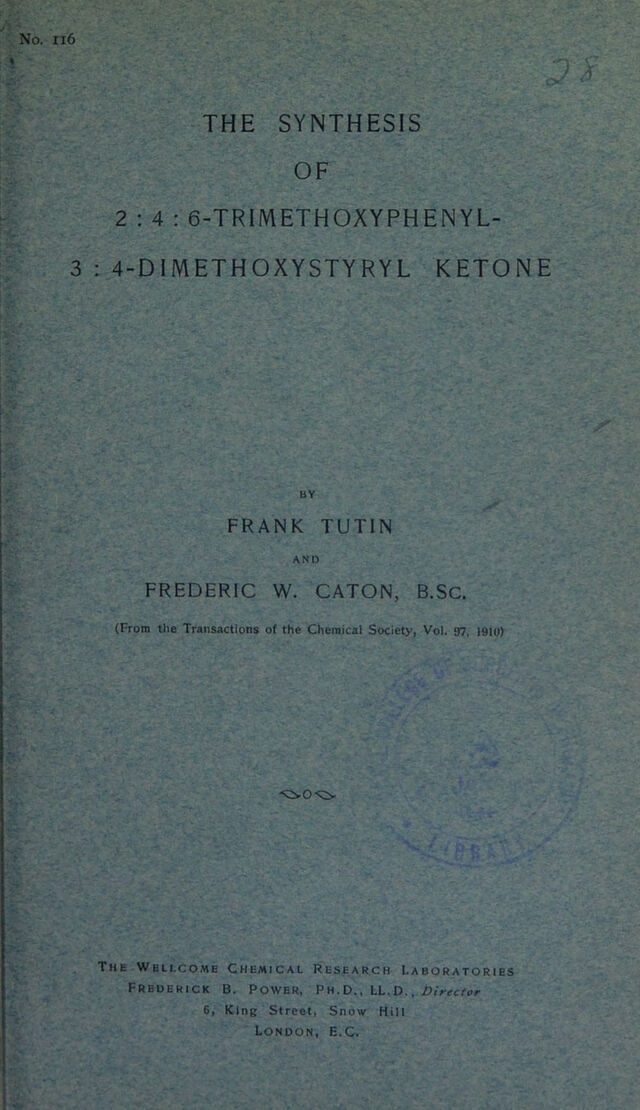
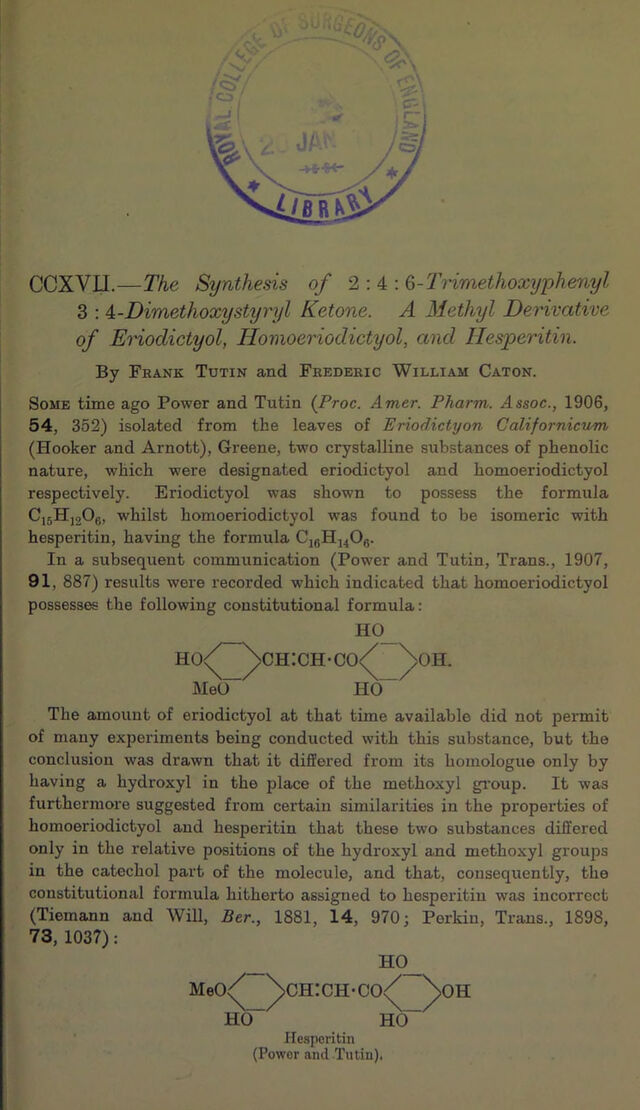
The synthesis of 2:4:6-trimethoxyphenyl-3:4-dimethoxystyryl ketone : [a methyl derivative of eriodictyol, homoeriodictyol, and hesperitin] / by Frank Tutin and Frederic W. Caton.
- Tutin, Frank.
- Date:
- 1910
Licence: Attribution 4.0 International (CC BY 4.0)
Credit: The synthesis of 2:4:6-trimethoxyphenyl-3:4-dimethoxystyryl ketone : [a methyl derivative of eriodictyol, homoeriodictyol, and hesperitin] / by Frank Tutin and Frederic W. Caton. Source: Wellcome Collection.
Provider: This material has been provided by The Royal College of Surgeons of England. The original may be consulted at The Royal College of Surgeons of England.
7/13 page 2066
![Acetoxydiacetyldimethoxyhenzene, OAc‘C(jH(OMe)2(CO*CH3)2. The acetyl derivative of the above-described compound was prepared by means of acetic anhydride. It crystallised from its concentrated solution in this solvent, and was purified by recrystallisation from benzene. AcetoxydiacetyldAmethoonjbenzene forms well-defined prisms, melting at 150‘5°: 01132 gave 0 2409 CO2 and 0-0572 H2O. C = 60-0; H = 5-6. requires C = 60-0; H = 5’7 per cent. This substance cannot be crystallised from ordinary alcohol or other hydrous solvents, as it is rapidly hydrolysed when dissolved in such liquids. Bemoyloxydiacetyldimedhoxyi enzene, OBz*C5H(OMe)2(CO*CH3)2. —This compound was prepared by the Schotten-Baumann reaction. It crystallised from benzene in cubes, and from absolute alcohol in slender prisms, melting at 179° : 0-1132 gave 0-2768 CO2 and 0 0551 H2O. 0 = 66 7; H = 5-4. CJ9H22O6 requires 0 = 66 7; H = 5-3 per cent. The analysis of this compound conclusively confirms the results I obtained by the analysis of the original hydroxy-diketone, inasmuch as the related compounds containing one and three acetyl groups would require 0 = 65-6 and 0 = 68 0 per cent, respectively. llydroxydiacetyldimethoxyhenzene-phenylhydrazone. — One gram of hydroxydiacetyldimethoxybenzene was dissolved in a small amount of alcohol, and slightly more than two molecular proportions of freshly distilled phenylhydrazine dissolved in acetic acid added. The mixture was heated on a water-bath for a quarter of an hour, when, after concentration, a crystalline product separated. This was collected, and crystallised many times, first from acetic acid, and subsequently from a mixture of ethyl acetate and alcohol, when the melting point gradually rose from 215° to 230°, the product finally obtained forming hexagonal prisms melting sharply at the latter temperature; 0-0927 gave 0-2248 CO2 and 0-0529 H2O. C = 66-l; H = 6-3. 0-1012 „ 8-4 c.c. N2 (moist) at 19° and 753 mm. N = 9-4. C]8H2(,04N2 requires 0 = 65 8; H = 6-l; N = 8 5 per cent. This compound was therefore a mono'yhenylhydrazone of hydroxy- diacetyldimethoxybenzene. The original ethereal mother liquors from the hydroxydiacetyl- dimethoxybenzene yielded a small amount of a substance which, when crystallised from alcohol, melted at 80°: 0-0754 gave 0 1685 COo and 0-0425 H2O. 0 = 61-2; H = 6-3. C,|jHj204 requires 0 = 61-2; H = 6-l per cent.](https://iiif.wellcomecollection.org/image/b2243317x_0009.jp2/full/800%2C/0/default.jpg)