Misstatements of antivivisectionists : correspondence with American humane association / [by] W.W. Keen.
- William Williams Keen
- Date:
- [1901]
Licence: Public Domain Mark
Credit: Misstatements of antivivisectionists : correspondence with American humane association / [by] W.W. Keen. Source: Wellcome Collection.
Provider: This material has been provided by the Augustus C. Long Health Sciences Library at Columbia University and Columbia University Libraries/Information Services, through the Medical Heritage Library. The original may be consulted at the the Augustus C. Long Health Sciences Library at Columbia University and Columbia University.
18/32 page 12
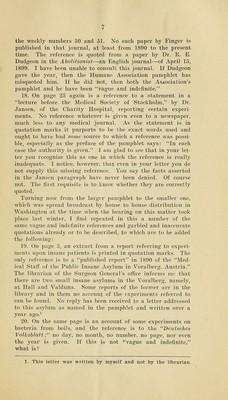
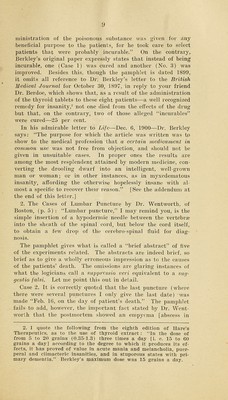
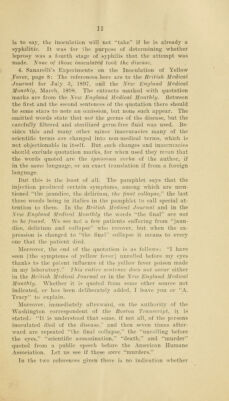
![any of these patients died or not. How, therefore, it is under- stood that some, if not all, of them died, I do not know. As a matter of fact none of the human beings inoculated by Sanarelli died, as any one desirous of learning the truth could have ascertained by consulting Sanarelli's original publication reporting his experiments with full details. (Annali d'Igiene Sperimentale, 1897, vol. vii, Fascic. iii, pp. 345 and 433.) What hysterical oratory about the final collapse, which was not final; scientific assassination, which did not as- sassinate; and murder of those who were so disobliging as- still to live! And this on the authority of the Washington cor- respondent of the Boston Transcript, who the pamphlet as- sures us is a person who would seem to be unusually well in- formed in matters of science! An excellent example of news- paper medicine'' and a good reason for my refusal to accept it as evidence, especially from other correspondents Avho may not be as unusually well informed. May I ask whether the Vienna correspondent of the London Morning Leader is also one of those who, in your opinion, is unusually well informed in matters of science, and whether his testimony is as wholly false as the one under consideration? 5. On page 23, the pamphlet quotes an account of some ex- periments of Dr. Neisser from the Medical Press and Circular [England], of March 29, 1899. This is an instance again of misquotation and omission which can scarcely be other than intentional. The last sentence of the first quotation states: of these eight girls, four developed syphilis. No stars in- dicate that any words have been omitted. The original reads: of these eight girls [five were prostitutes, and of these five] four developed syphilis. The words in brackets are entirely omitted in the pamphlet. They make a deal of difference, for what is more probable than that four out of five prostitutes- should develop syphilis? Whether it makes any differences or not, however, is at present not the question. The issue i& whether the quotation is garbled and inaccurate. Does it not fulfill another of the definitions of garbling given in your letter, viz: omissions of essential facts . . . , sufficient to impair the accuracy or fairness of the quotation? Moreover the pamphlet's comment upon this case is as fol- lows: Does the London journal which reports these awful ex- periments denounce them as a crime against every law of mor- ality? Not at all. It simply says that 'it would be difficult to acquit Dr. Neisser of a large measure of responsibility in respect of the causation of syphilis in these eases!' Could re- proof be more gentle? Is that really all that the Medical Press and Circular sim- ply says? On turning to that journal, after the above sen-](https://iiif.wellcomecollection.org/image/b21217002_0018.jp2/full/800%2C/0/default.jpg)



 No text description is available for this image
 No text description is available for this image
 No text description is available for this image