Volume 2
Cyclopædia of India and of eastern and southern Asia, commercial, industrial and scientific : products of the mineral, vegetable and animal kingdoms, useful arts and manufactures / edited by Edward Balfour.
- Date:
- 1857
Licence: Public Domain Mark
Credit: Cyclopædia of India and of eastern and southern Asia, commercial, industrial and scientific : products of the mineral, vegetable and animal kingdoms, useful arts and manufactures / edited by Edward Balfour. Source: Wellcome Collection.
46/872 page 1242
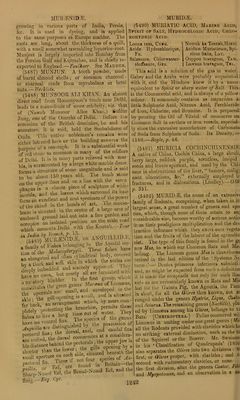
![MUR.ENID.E. growing in various parts of India, Persia, &c. It is used in dyeing, and is applied to the same purposes as Europe madder. The roots are long, about the thickness of a quill, with a smell somewhat resembling liquorice-root. Munjeet is largely imported into Bombay from the Persian Gulf and KuVrachee, and is chiefly re- exported to England.—Faulkner. See Madder, (5487) MUNJUN. A tooth powder, made of burnt almond shells ; or common charcoal: or charcoal made from myrobalans or betel nuts.—Herklots. (5488) MUNSOOR ATT KHAN'. An almost direct road from Hoomayoon’s tomb near Delhi, leads to a mausoleum of some celebrity, viz. that of (Nawnb Munsoor Allee Khan,) Sufdur Jung, one of the Omrahs of Delhi. Before the accession of the. British dominion, he and his ancestors, it is said, held the Soobahdaree of Oude This native nobleman’s remains were either interred here or the building answeis the purpose of a cenotaph. It is a substantial work of red stone so common in many of the edifices of Delhi U is in many parts relieved with mar- ble is surmounted by a large white marble dome forms a structure of some magnitude and is sau to be about 150 years old. The tomb stone on the upper floor and on a line with the sarco pha ms is a chaste piece of sculpture of wlnt „-,rble and the leaves which surround its base form an excellent and neat specimen of the power of the chisel in the hands of art. 1 he mauso- leum is situated in the centre of a large area of enclosed ground laid out into a hue garden and occupies an isolated position on the main road which connects Delhi with the Kootub.—lour in India by French, p■ 1 8- -._,TTr, T , n v (54811) MUR/EN1D-E, or AN GUILE n « family of Eishes belonging to the Apodal sec- tion of‘the Malucopterygii- These fishes have 1 elongated and often cylindrical body, covered , p, _ 1 cl-In in which the scales are MU RULE. (5490) MURIATIC ACID, Marine Acid, Spirit of Salt, Hydrochloric Acid, Ciilo- rohydric Acid. Loona rasa, Cyhg. Nemuk ka Teezab.HiNi). Acidum Muriaticum, Spi- Acide Ilydrochlorique, Er. Salzsaure, Chlorwasser- stoffsaure, Gek. ritus Salis, Lat. Ooppoo travagum, Tam. Lawana travagum, Til. This acid is a solution of the gas in water. Geber and the Arabs were probably acquainted 1 with it, and the Hindoos knew it by a name: equivalent to Spirit or sharp water of Salt. This is the Commercial acid, and is always of a yellow colour. It commonly contains as impurities a. little Sulphuric Acid, Nitrous Acid, Perchloride of Iron, Chlorine, and Bromine. It is prepared, bv pouring the Oil of Vitriol of commerce on Common Salt in earthen or iron vessels, especial- ly since the extensive manufacture of Carbonate! of Soda from Sulphate of Soda. Its Density, == 1180.—Royle,p. 46. (5491) MU MCI A COCHINCHINENSIS- A native of China, Cochin China, a large shrub, berry large, reddish purple, scentless, insipid : seeds and leaves aperient, and used by the Chi-i nese in obstructions of the liver, “ tumors, malig- nant ulcerations, &o.” externally employed ii fractures, and in dislocations. (Lindley).—OS/r v. 351. (5492) MURID.E, the name of an extensivt family of Rodents, comprising, when taken in it largest sense, a great number of genera and spe< cies, which, though none of them attain to an; akin in which imbedded and scarcely apparent. limy deeply nearly all are furnished will taVe,In WadS the first group, whicl na, •.the great genus Mur ana ot Linmeus, fte onercula are small, and enveloped n> the kin- the gill-opening is small, and is situated 11,'ack. a» arrangement whM>, kjMnore com- =.ts £ k 1 y,QSTa long time oat of water. They fishes to i s 1 S The species of the genus have no ventral nns i , possession of pectoral fins , th (;uces at a considera- uC Hbehind the pectorals ; the upper jaw is ble distance oeninu i opening by a thaw ‘^ride, sifuated heneatl, the small aperture on f r SJ?ecies of An- pectoral fin. 1 >'« d ”foa|1(1 in Britain tile guilla, or Eel, ai ^ , xr _„j t?,,i *nr1 t.lip. Slimp-Noaed 15ei, the Broad-Noeod Eel, and the Snig. -Eng. Cyc 12 WAVtJJ *****-w”> O . . ' considerable size, become worthy of serious notie- from their prodigious multiplication and the des tractive influence which they exert over vegeta Lion and the fruits of the labour of the agricultu rist. The type of this family is found in the gt; nns Mus, to which our Common Rats and Mu. belong. The Linnean genus Mus is Lhuscharau terised m the last edition of the ‘ by sterna Ni tul.;i.—• Dentes primores ihferiorcs subulati, and, as might be expected from such a definitioi it is made the receptacle not only l'or such Roo eni s as are vernacularly known as Rats and Mir but l'or the Guinea Pig, the Agoutis, the Fact in short, for all the Gil ires then known, not or ranged under the genera Hystrix, Liqus, Casio and Sciurus. The remaining genus (A octilio), pla ed by Linnaeus among his Glires, belongs to ti Bats. [Cheiroptera.] Pallas concurred wi. Linnaeus in uniting under one great genus {Mi all the Rodents provided with clavicles which hi no striking external distinction, such as the t. of the Squirrel or the Beaver. Mr. Swamso. in his ‘Classification of Quadrupeds’ (ISoi also separates the Glires into two divisions : ti first, or Glires proper, with clavicles; and ti second with rudimentary clavicles, or none- the first division, alter the genera Castor, FUk and Myopotomus, and an observation in a at 12](https://iiif.wellcomecollection.org/image/b28708921_0002_0046.jp2/full/800%2C/0/default.jpg)