On internal tumours : their characteristic distinctions, and diagnosis / by Walter Balls-Headley.
- Headley, Walter Balls.
- Date:
- 1876
Licence: Public Domain Mark
Credit: On internal tumours : their characteristic distinctions, and diagnosis / by Walter Balls-Headley. Source: Wellcome Collection.
Provider: This material has been provided by the Francis A. Countway Library of Medicine, through the Medical Heritage Library. The original may be consulted at the Francis A. Countway Library of Medicine, Harvard Medical School.
22/196 (page 6)
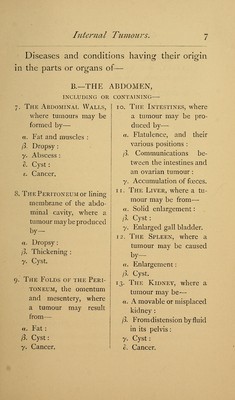
![A.—THE PELVIS, The Ovary, of which— (a) Fhiid tumours may be- et. Graafian cystic, with or without solid mat- ter (commonly called ovarian dropsy or tu- mour) : /3. Dermoid: y. Hydatid: I. Primary abscess. (b) Solid tumours may be— £. Inflammation : 'C, Hypertrophy: ?;. Fibrous tumour: 0. Cancer. The Fallopian Tube AND Broad Ligainient, connecting the ovary with the womb — of which a tumour maybe— a. Distension by blood, 5. serous, or purulent fluid /3. Pregnancy: y. Cyst: f. Abscess. The Womb : (a) a tumour within its cavity may be— a. Pregnancy: /3. Hydatid-like degene- ration of the mem- branes : containing— . y. Distension by fluid or gas: c. Fibrous tumour or polypus. (b) In its walls— £. Misplacement: 4. Hypertrophy: 7], Fibrous tumour : 0. Fibro-cystic tumour : t. Abscess: K. Cancer. (c) Outside its walls, but connected with it, there may be— X. Fibrous tumour: II. Fibro-cystic tumour. The Bladder, where a tumour may be caused by- o. Distension from retained urine. The Low^er Bowel, where a tumour may be caused by- a. Impactioti of foeces from constipation. The Connecting Tissue, where a tumour may be produced by— a. Abscess :^ /3. Blood poured out around the womb.](https://iiif.wellcomecollection.org/image/b21057618_0022.jp2/full/800%2C/0/default.jpg)