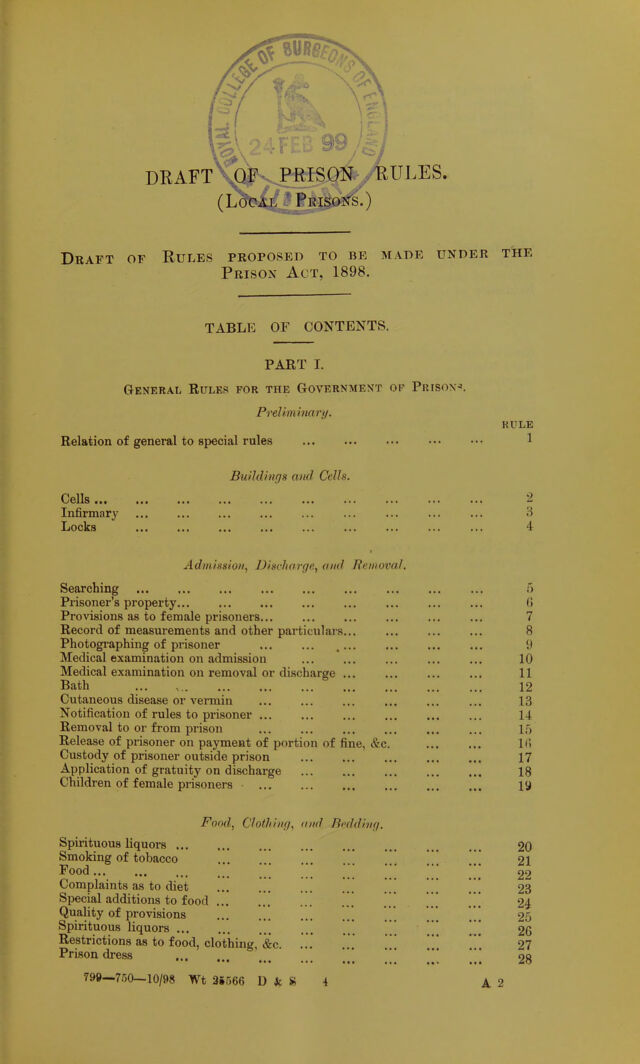
Prison rules (local prisons) : draft of rules proposed to be made under the Prison Act, 1898.
- Home Office
- Date:
- 1899
Licence: Public Domain Mark
Credit: Prison rules (local prisons) : draft of rules proposed to be made under the Prison Act, 1898. Source: Wellcome Collection.
Provider: This material has been provided by The Royal College of Surgeons of England. The original may be consulted at The Royal College of Surgeons of England.
16/60 page 16
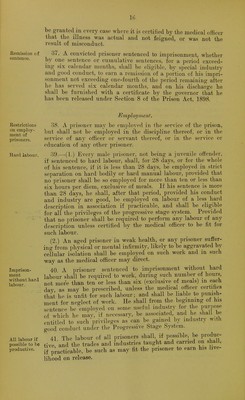
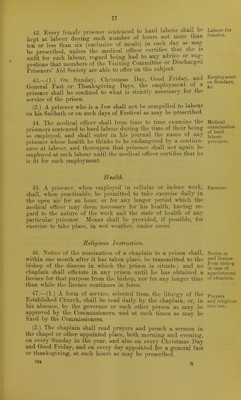
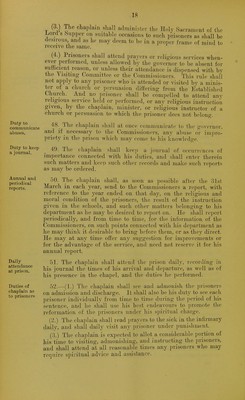
![Remission of sentence. Restrictions on employ- ment of prisoner's. Hard labour. i . Imprison- ment without hard labour. All labour if possible to be productive. be f>Tanted in every case where it is certified by the medical officer that the illness was actual and not feigned, or was not the result of misconduct. 37. A convicted prisoner sentenced to imprisonment, whether by one sentence or cumulative sentences, for a peiiod exceed- ing six calendar months, shall be eligible, by special industiy and good conduct, to earn a remission of a portion of his impri- sonment not exceeding one-fourth of the period remaining after he has served six calendar months, and on his discharge he shall be furnished with a certificate by the governor that he has been released under Section 8 of the Prison Act, 1898. Employment. 38. A prisoner may be em])loyed in the service of the prison, but shall not be employed in the discipline thereof, or in the service of any officer or servant thereof, or in the service or education of any other prisoner. 39.—(1.) Every male prisoner, not being a juvenile offender, if sentenced to hard labour, shall, for 28 days, or for the whole of his sentence, if it is less than 28 days, be employed in strict separation on hard bodily or hard manual labour, provided that no prisoner shall be so employed for more than ten or less than six hours per diem, exclusive of meals. If his sentence is more than 28 days, he shall, after that period, provided his conduct and industry are good, be employed on labour of a less hard description in association if practicable, and shall be eligible for all the privileges of the progressive stage system. Provided that no prisoner shall be required to perfonn any labour of any description unless certified by the medical officer to* be fit for such labour. (2.) An aged prisoner in weak health, or any prisoner suffer- ing from physical or mental infirmity, likely to be aggravated by cellular isolation shall be employed on such work and in such way as the medical officer may direct. 40. A prisoner sentenced to imprisonment without hard ibour shall be required to work, during such number of hours, ot more than ten or less than six (exclusive of meals) in each ay as may be prescribed, unless the medical officer certifies liat he is unfit for such labour; and shall be liable to punish- lent for neglect of work. He shall from the beginmng of his mtence be employed on some useful industry for the F^i’P^^se f which he may,' if necessary, be associated, and he shall be ntitled to such' privileges as can be gained by industry wi ood conduct under the Progressive Stage System. 41 The labour of all prisoners shall, if possible, be produc- Ive and the trades and industries taught and carried on shall, 5 practicable, be such as may fit the prisoner to earn his live- hood on release.](https://iiif.wellcomecollection.org/image/b22333782_0018.jp2/full/800%2C/0/default.jpg)