Glass and British pharmacy, 1600-1900 : a survey and guide to the Wellcome Collection of British glass / J.K. Crellin and J.R. Scott.
- Wellcome Institute of the History of Medicine
- Date:
- 1972
Licence: Attribution 4.0 International (CC BY 4.0)
Credit: Glass and British pharmacy, 1600-1900 : a survey and guide to the Wellcome Collection of British glass / J.K. Crellin and J.R. Scott. Source: Wellcome Collection.
20/96 (page 4)
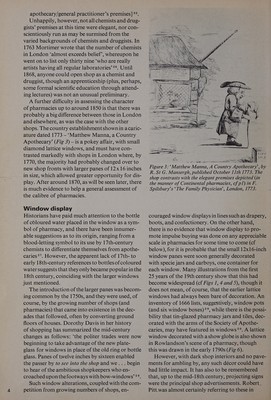
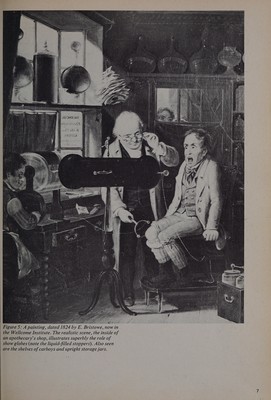
![apothecary/general practitioner’s premises] 2°. Unhappily, however, not all chemists and drug- gists’ premises at this time were elegant, nor con- scientiously run as may be surmised from the varied backgrounds of chemists and druggists. In 1763 Mortimer wrote that the number of chemists in London ‘almost exceeds belief’, whereupon he went on to list only thirty nine ‘who are really artists having all regular laboratories’ ?®. Until 1868, anyone could open shop as a chemist and druggist, though an apprenticeship (plus, perhaps, some formal scientific education through attend- ing lectures) was not an unusual preliminary. A further difficulty in assessing the character of pharmacies up to around 1850 is that there was probably a big difference between those in London and elsewhere, as was the case with the other shops. The country establishment shownin acaric- ature dated 1773 — ‘Matthew Manna, a Country Apothecary’ (Fig 3) — is a pokey affair, with small diamond lattice windows, and must have con- trasted markedly with shops in London where, by 1770, the majority had probably changed over to new shop fronts with larger panes of 12x 16 inches in size, which allowed greater opportunity for dis- play. After around 1870, as will be seen later, there is much evidence to help a general assessment of the calibre of pharmacies. Window display Historians have paid much attention to the bottle of coloured water placed in the window as a sym- bol of pharmacy, and there have been innumer- able suggestions as to its origin, ranging froma blood-letting symbol to its use by 17th-century chemists to differentiate themselves from apothe- caries 2’. However, the apparent lack of 17th- to early 18th-century references to bottles of coloured water suggests that they only became popular inthe 18th century, coinciding with the larger windows just mentioned. The introduction of the larger panes was becom- ing common by the 1750s, and they were used, of course, by the growing number of shops (and pharmacies) that came into existence in the dec- ades that followed, often by converting ground floors of houses. Dorothy Davis in her history of shopping has summarized the mid-century changes as follows: ‘the politer trades were now beginning to take advantage of the new plate- glass for windows in place of the old ring or bottle glass. Panes of twelve inches by sixteen enabled the passer by to see into the shop and we... begin to hear of the ambitious shopkeepers who en- croached upon the footways with bow-windows’?8. Such window alterations, coupled with the com- petition from growing numbers of shops, en- ened Soe Figure 3: ‘Matthew Manna, A Country couraged window displays in lines such as drapery, — boots, and confectionery. On the other hand, there is no evidence that window display to pro- mote impulse buying was done on any appreciable scale in pharmacies for some time to come (cf below), for it is probable that the small 12x16-inch window panes were soon generally decorated with specie jars and carboys, one container for each window. Many illustrations from the first 25 years of the 19th century show that this had become widespread (cf Figs 1, 4 and 5), though it does not mean, of course, that the earlier lattice windows had always been bare of decoration. An inventory of 1666 lists, suggestively, window pots (and six window boxes) **, while there is the possi- bility that tin-glazed pharmacy jars and tiles, dec- orated with the arms of the Society of Apothe- caries, may have featured in windows?’. A lattice window decorated with ashow globe is also shown in Rowlandson’s scene of a pharmacy, though this was drawn in the early 1790s (Fig 6). However, with dark shop interiors and no pave- ments for ambling by, any such décor could have had little impact. It has also to be remembered that, up to the mid-18th century, projecting signs were the principal shop advertisements. Robert Pitt.was almost certainly referring to these in](https://iiif.wellcomecollection.org/image/b33294185_0020.jp2/full/800%2C/0/default.jpg)