Glass and British pharmacy, 1600-1900 : a survey and guide to the Wellcome Collection of British glass / J.K. Crellin and J.R. Scott.
- Wellcome Institute of the History of Medicine
- Date:
- 1972
Licence: Attribution 4.0 International (CC BY 4.0)
Credit: Glass and British pharmacy, 1600-1900 : a survey and guide to the Wellcome Collection of British glass / J.K. Crellin and J.R. Scott. Source: Wellcome Collection.
21/96 (page 5)
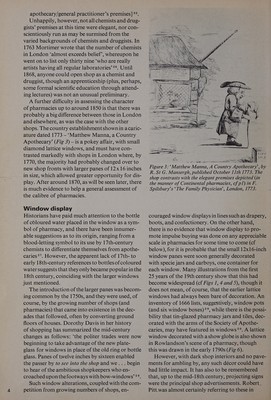
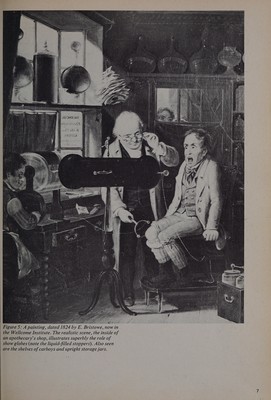
![Figure 4: D. T. Egerton’s scene in an apothecary’s shop, the front windows being decorated with specie jars and show globes or carboys. Dated 1824. Another caricature by Egerton, entitled ‘Vis a Vis’ (c.1824), of a scene outside a pharmacy, shows a similar window display, 1704, when he said that every alley or passage had a painted pot [of an apothecary] *!. (Chemists were probably using Boyle’s head, Glauber’s head, or other signs at the time??.) In London, at least, projecting signs had become such a danger and nuisance by the 1760s that they were prohibited *°. This necessitated other methods of drawing atten- tion to the premises, and may have contributed to the growing popularity of the bottle of coloured liquid by both apothecaries and chemists and druggists, as much as did the larger windows. a. Cylindrical specie jars _ From what has been said it is clear that much - glassware was available for window dressing when the new larger windows came into vogue. The use of glass vessels for displaying drugs is confirmed by a rather scurrilous remark, made in 1748, that if an apothecary purchased four ounces of good quality drug, he would keep it in a ‘glass and shew his customers’, but at the same time use material of inferior quality for making medicines ?*. Such display glasses were sometimes referred to as specie glasses, which Gideon Harvey said, in 1689, ‘burthen’d’ apothecary shops®*>. In the 19th century the adjective ‘specie’ always referred to to suppose that the 17th- to 18th-century specie glasses were not of the same shape. Certainly, water-white, cylindrical jars filled with coloured liquids (average height 12 inches) appear in many illustrations of the early 19th century, and it may be that Lichtenberg meant this type when speak- ing, in 1775, of display glasses in apothecaries’ and druggists’ windows filled with gay-coloured liquids °°. Likewise, Gottling may have been refer- ring to the same in 1787 (chemists’ and druggists’ shops having ‘glasses with individually ground stoppers filled with green, blue and yellow liquids’ 3”), but, by this time, at least, ‘show globes’ were regular items of commerce, even being exported to America. Griffenhagen has noted that the New York Daily Advertiser for October 5th 1789 records ‘large show globes, specie and stopper bottles’ being received from Bristol ®®. Yet, whatever the shape (cylindrical or global) of the vessels referred to by Gottling in 1787, the ground stoppers filled with green, blue or yellow liquid indicate that the vessels were specially de- signed for display, although they may not then have been specifically associated with pharmacy as they undoubtedly were a few decades later (cf Fig 5). In 1786 Sophie von la Roche wrote home](https://iiif.wellcomecollection.org/image/b33294185_0021.jp2/full/800%2C/0/default.jpg)