Recognizable patterns of human malformation : genetic, embryologic, and clinical aspects / by David W. Smith.
- David Weyhe Smith
- Date:
- 1976
Licence: Attribution-NonCommercial 4.0 International (CC BY-NC 4.0)
Credit: Recognizable patterns of human malformation : genetic, embryologic, and clinical aspects / by David W. Smith. Source: Wellcome Collection.
50/534 (page 24)
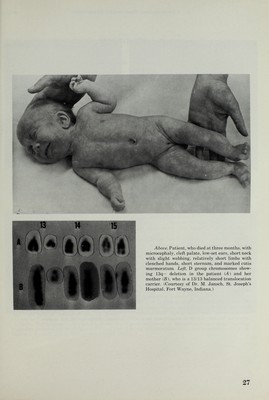
![A. Chromosomal Abnormality Syndromes CRI-DU-CHAT SYNDROME (Partial Deletion of the Short Arm of Chromosome Number 5 Syndrome) Cat-Like Cry in Infancy, Microcephaly, Downward Slant of the Palpebral Fissures Lejeune et al.^ first described this condition in 1963. Further reports have raised to about 30 the number of cases described. ABNORMALITIES General. Low birth weight (less than 2.5 kg) Slow growth Cat-like cry Performance. Mental deficiency Hypotonia Craniofacial. Microcephaly Round face Hypertelorism Epicanthic folds Downward slanting of the palpebral fissures Strabismus, often divergent Low-set and/or poorly formed ears Facial asymmetry Heart. Congenital heart disease (variable in type) Hands. Simian crease Distal axial triradius Mildly short metacarpals 72% 100% 100% 100% 78% 100% 68% 94% 85%. 81% 61% 58% 30% 81% 40% OCCASIONAL ABNORMALITIES. Cleft lip and cleft palate, myopia, optic atrophy, preauric¬ ular skin tag, bifid uvula, dental malocclusion, short neck, clinodactyly, inguinal hernia, cryp¬ torchidism, absent kidney and spleen, and hemi¬ vertebra, scoliosis, flat feet, and premature gray¬ ing of hair. NATURAL HISTORY. Birth weight has ranged from 1600 to 3570 grams with a mean of 2650 grams. As babies they tend to be unusually squirmy in their activity. The mewing cry, ascribed to abnormal laryngeal development, becomes less pronounced with increasing age of the patient, thus making the diagnosis more dif¬ ficult in older patients. The LQ. is most com¬ monly in the 20 to 30 range. The majority be¬ come ambulatory; however, only one patient has developed limited speech. Scoliosis is a frequent occurrence. ETIOLOGY. The underlying chromosomal aberration, partial deletion of the short arm of chromosome number 5, has appeared as a fresh phenomenon in the majority of the cases. A bal¬ anced translocation parent, with an increased risk for recurrence, has been found in 10 to 15 per cent of the cases. REFERENCES 1. Lejeune, J., Lafourcade, J., Berger, R., Vialatte, J., Boeswillwald, M., Seringe, P., and Turpin, R.: Trois cas de délétion partielle du bras court du chromosome 5. C. R. Acad. Soi. [D] (Paris), 257:3098, 1963. 2. Berg, J. M., Delhanty, J. D. A., Faunch, J. A., and Ridler, M. A. C.: Partial deletion of short arm of a chromosome of the 4 and 5 group (Denver) in an adult male. J. Ment. Defic. Res., 5:219, 1965. 3. Breg, W. R., et al.: The Cri-du-chat syndrome in ad¬ olescents and adults. J. Pediatr., 77:782, 1970. 24](https://iiif.wellcomecollection.org/image/b1803018x_0051.JP2/full/800%2C/0/default.jpg)