Remarks on the diagnosis and treatment of diseases of the brain : delivered at a meeting of the Worcestershire and Herefordshire, Bath and Bristol, and Gloucestershire branches / by J. Hughlings Jackson.
- Jackson, John Hughlings, 1834-1911.
- Date:
- [1888]
Licence: Public Domain Mark
Credit: Remarks on the diagnosis and treatment of diseases of the brain : delivered at a meeting of the Worcestershire and Herefordshire, Bath and Bristol, and Gloucestershire branches / by J. Hughlings Jackson. Source: Wellcome Collection.
Provider: This material has been provided by The Royal College of Surgeons of England. The original may be consulted at The Royal College of Surgeons of England.
5/32
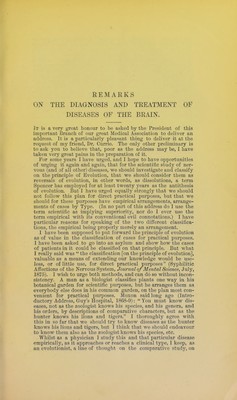
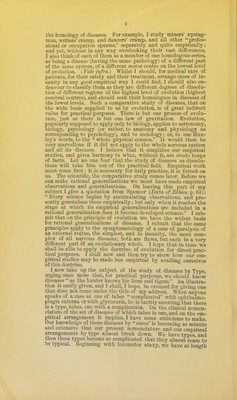
![REMARKS ON THE DIAGNOSIS AND TREATMENT OF DISEASES OF THE BRAIN. It is a very great honour to be asked by the President of this important Branch of our great Medical Association to deliver an address. It is a particularly pleasant thing to deliver it at the request of my friend, Dr. Currie. The only other preliminary is to ask you to believe that, poor as the address may be, I have taken very great pains in the preparation of it. For some years I have urged, and I hope to have opportunities of urging it again and again, that for the scientific study of ner- vous (and of all other) diseases, we should investigate and classify on the principle of Evolution, that we should consider them as reversals of evolution, in other words, as dissolutions, a term Spencer has employed for at least twenty years as the antithesis of evolution. But I have urged equally strongly that we should not follow this plan for direct practical purposes, but that we should for these purposes have empirical arrangements, arrange- ments of cases by Type. (In no part of this address do I use the term scientific as implying superiority, nor do I ever use the term empirical with its conventional evil connotations.) I have particular reasons for speaking of the two different classifica- tions, the empirical being properly merely an arrangement. I have been supposed to put forward the principle of evolution as of value in the classification of cases for practical purposes. I have been asked to go into an asylum and show how the cases of patients in it could be classified on that principle. But what I really said was the classification [on the principle of evolution], valuable as a means of extending our knowledge would be use- less, or of little use, for direct practical purposes (Syphilitic Affections of the Nervous System, Journal of Mental Science, July, 1875). I wish to urge both methods, and can do so without incon- sistency. A man as a biologist classifies plants one way in his botanical garden for scientific purposes, but he arranges them as everybody else does in his common garden, on the plan most con- venient for practical purposes. Moxon said long ago (Intro- ductory Address, Guy's Hospital, 1868-9): You must know dis- eases, not as the zoologist knows his species, and his genera, and his orders, by descriptions of comparative characters, but as the hunter knows his lions and tigers. I thoroughly agree with this in so far that we should try to know diseases as the hunter knows his lions and tigers, but I think that we should endeavour to know them also as the zoologist knows his species, etc. Whilst as a physician I study this and that particular disease empirically, as it approaches or reaches a clinical type, I keep, as an evolutionist, a line of thought on the comparative study, on](https://iiif.wellcomecollection.org/image/b22303273_0007.jp2/full/800%2C/0/default.jpg)