Volume 1
Report of the Commissioners appointed in 1898 to inquire and report what methods of treating and disposing of sewage (including any liquid from any factory or manufacturing process) may properly be adopted.
- Great Britain. Royal Commission on Sewage Disposal.
- Date:
- 1902-1915
Licence: Public Domain Mark
Credit: Report of the Commissioners appointed in 1898 to inquire and report what methods of treating and disposing of sewage (including any liquid from any factory or manufacturing process) may properly be adopted. Source: Wellcome Collection.
33/1256 page 9
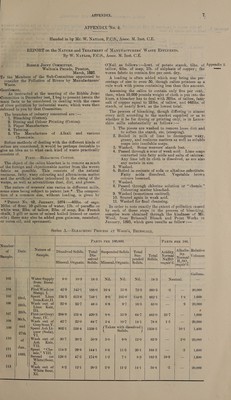
![Series B. ANALYSES OF AVERAGE BLEAC H WASTE SHOWING. ORGANIC MATTER. Parts per 100,000. o . : : oO * . F- Date. Nature of Sample. iS heute (ee te LER 2¢ J be 2 | ci) eee) 2 ee )ah! 5 | gh! 2 FI = S oe pa Sa S) xO Ss IN BD © es 25 5 Peto eece | a ea) poe BS | 25 Zo H |e4 |444| 5 |S0/o7 AA | Ae EE a) ae ea aE SS ol i 1 C0 rus en (A a es ees ee ee 129 9 Feb. 1893 - | Samples of waste bleach liquor | 186-0) °012 0 10 | 1°45 | -056| 26 tol | 009 | ‘065 taken every three hours and | mixed. (Whalley Abbey Print Co.) 17 3 Feb. 1893 - | Samples (coloured+) of waste | 86:1; ‘03 al 40 | 9°03 | -87 |10 tol | *125 | -:995. bleach liquor taken half ; hourly and mixed. (Graf- ton and Co., Accrington). 128 | 10 Feb. 1893 - | Samples of waste bleach liquor | 136°5 | *24 0 130 | 26°124| 2-734] 9tol | -19 | 2-924 taken half hourly and mixed. | (Stanning’s, Leyland). ~ * Due principally to acids. NoTeE.—The above samples and all to follow were accepted can only be strictly considered Srconp.—DyYEING snp Catico PRINTING. DYEING. Dyeing is briefly the process of passing fabrics through solutions of colouring matter, under conditions favour- able either to the temporary or permanent retention of the colouring matter by the fabric. There are many colours which, though not readily absorbed by the fabric itself, are capable of fixing themselves upon some agent with which the fabric may be saturated, which agent is termed a mordant. Different mordants are used for different colours, one colouring agent often changing its tone altogether with a different mordant. _The colours used in the Ribble Watershed are prin- cipally alizarine, logwood, and indigo, from which there 1s no waste thrown into the river until after the point of making coloured solutions or dyes. K Goods are passed through the solutions after mordant- ing, then washed ; certain colours are afterwards soaped also, that they may acquire a finished, polished, or brighter appearance, and then washed again. Series C.—ANALYSES OF DysE + Coloured by “ back pieces.” from manufacturers as bona fide specimens of waste, but as such for the time defined. — Carico PRINTING. ‘ Calico printing is the art of dyeing designs topically upon calico having either a white or already coloured ground. The colour is first placed upon wooden blocks or engraved copper cylinders, from which it is after- wards transferred to the fabric. This causes calico printers’ waste liquor to be of a more obnoxious char- acter than that from dyers, for before the colour will adhere to the blocks or engraved cylinders it must be thickened by a paste, which paste is afterwards washed out, the colour being left behind. The principal thick- ening agents are:—Albumen, casein, china clay, pipe clay, dextrin, glue, gluten, glycerine, gum senegal, gum shellac in borax, sugar, wheat flour, wheat starch, zinc chloride, and zinc nitrate. (Gardner). The “‘ whites” or pieces to be printed are run between the plain and engraved cylinders, together with blankets. and “ back pieces” or “back greys,” which in due course become themselves smeared or coloured, and upon being washed and bleached give a colouration to the bleach. waste. AND Catico Print Liquors. Parts per 100,000. Number - of Date Nature of Sample. Dissolved Solids. Suspended Solids. Sample. Total Total Total ‘Dissolved|— Suspended] « ids _. | Solids. | xy: Wo eolida. |e Mineral. | Organic. Mineral. | Organic. | | | 103 | 26 Jan. 1893. | Water from’ Wood’s |, 8-0 10°3 18°3 Sas Reta ge aA OS Reservoir, Brinseall. | | 115 26 Jan. 1898. eae net (Wood’s) 68°0 | 256:2 324-2 1:0 41°5 42°5 366°7. rom becks. . | - | 116 26 Jan. 1893. veo a Dye Becks 22°] 482 | 70°3 42°0 118°9 160°9 231 °2? ood’s). | 118 3 Feb. 1893 - | Dye and Calico Print | 146:1 41-9 188-0 10:2 6:1 16-3 204°3- Waste, Grafton & Co., | Accrington. | 135 9 Feb. 1893 - | Dye and Calico Print | 26-4 283 | BAY 8°0 14 | 94 64°1 Waste, Whalley Abbey Print Co. ‘30 | 10 Feb. 1893- | bye Se Stanning’s, 90-4 80°2 176°6 12:2 31°2 | 43°4 | 220°0 eyland. 1213,](https://iiif.wellcomecollection.org/image/b32179972_0001_0033.jp2/full/800%2C/0/default.jpg)


 No text description is available for this image
 No text description is available for this image
 No text description is available for this image