Affinity labelling and cloning of steroid and thyroid hormone receptors / edited by H. Gronemeyer.
- Date:
- [1988]
Licence: Attribution-NonCommercial-NoDerivatives 4.0 International (CC BY-NC-ND 4.0)
Credit: Affinity labelling and cloning of steroid and thyroid hormone receptors / edited by H. Gronemeyer. Source: Wellcome Collection.
263/332 (page 259)
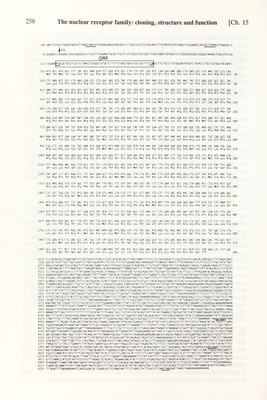
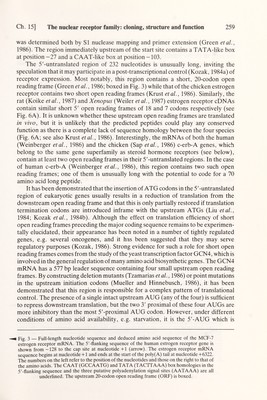
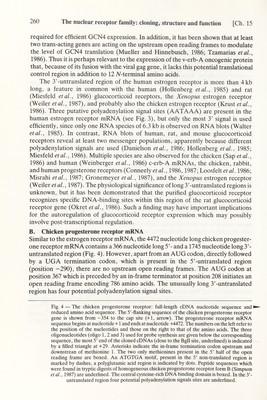
![Ch. 15] The nuclear receptor family: cloning, structure and function 259 was determined both by SI nuclease mapping and primer extension (Green et al., 1986). The region immediately upstream of the start site contains a TATA-like box at position -27 and a CAAT-like box at position -103. The 5'-untranslated region of 232 nucleotides is unusually long, inviting the speculation that it may participate in a post-transcriptional control (Kozak, 1984a) of receptor expression. Most notably, this region contains a short, 20-codon open reading frame (Green et al., 1986; boxed in Fig. 3) while that of the chicken estrogen receptor contains two short open reading frames (Krust et al., 1986). Similarly, the rat (Koike et al., 1987) and Xenopus (Weiler et al., 1987) estrogen receptor cDNAs contain similar short 5' open reading frames of 18 and 7 codons respectively (see Fig. 6A). It is unknown whether these upstream open reading frames are translated in vivo, but it is unlikely that the predicted peptides could play any conserved function as there is a complete lack of sequence homology between the four species (Fig. 6A; see also Krust et al., 1986). Interestingly, the mRNAs of both the human (Weinberger et al., 1986) and the chicken (Sap et al., 1986) c-erb-A genes, which belong to the same gene superfamily as steroid hormone receptors (see below), contain at least two open reading frames in their 5'-untranslated regions. In the case of human c-erb-A (Weinberger et al., 1986), this region contains two such open reading frames; one of them is unusually long with the potential to code for a 70 amino acid long peptide. It has been demonstrated that the insertion of ATG codons in the 5'-untranslated region of eukaryotic genes usually results in a reduction of translation from the downstream open reading frame and that this is only partially restored if translation termination codons are introduced inframe with the upstream ATGs (Liu et al., 1984; Kozak et al., 1984b). Although the effect on translation efficiency of short open reading frames preceding the major coding sequence remains to be experimen¬ tally elucidated, their appearance has been noted in a number of tightly regulated genes, e.g. several oncogenes, and it has been suggested that they may serve regulatory purposes (Kozak, 1986). Strong evidence for such a role for short open reading frames comes from the study of the yeast transcription factor GCN4, which is involved in the general regulation of many amino acid biosynthetic genes. The GCN4 mRNA has a 577 bp leader sequence containing four small upstream open reading frames. By constructing deletion mutants (Tzamarias et al., 1986) or point mutations in the upstream initiation codons (Mueller and Hinnebusch, 1986), it has been demonstrated that this region is responsible for a complex pattern of translational control. The presence of a single intact upstream AUG (any of the four) is sufficient to repress downstream translation, but the two 3' proximal of these four AUGs are more inhibitory than the most 5'-proximal AUG codon. However, under different conditions of amino acid availability, e.g. starvation, it is the 5'-AUG which is Fig. 3 — Full-length nucleotide sequence and deduced amino acid sequence of the MCF-7 estrogen receptor mRNA. The 5'-flanking sequence of the human estrogen receptor gene is shown from -128 to the cap site at nucleotide +1 (arrow). The estrogen receptor mRNA sequence begins at nucleotide +1 and ends at the start of the poly(A) tail at nucleotide+6322. The numbers on the left refer to the position of the nucleotides and those on the right to that of the amino acids. The CAAT (GCCAATG) and TATA (TACTTAAA) box homologies in the 5'-flanking sequence and the three putative polyadenylation signal sites (AATAAA) are all underlined. The upstream 20-codon open reading frame (ORF) is boxed.](https://iiif.wellcomecollection.org/image/b18029310_0264.JP2/full/800%2C/0/default.jpg)