Affinity labelling and cloning of steroid and thyroid hormone receptors / edited by H. Gronemeyer.
- Date:
- [1988]
Licence: Attribution-NonCommercial-NoDerivatives 4.0 International (CC BY-NC-ND 4.0)
Credit: Affinity labelling and cloning of steroid and thyroid hormone receptors / edited by H. Gronemeyer. Source: Wellcome Collection.
283/332 (page 279)
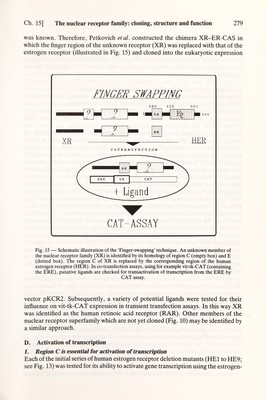
![Ch. 15] The nuclear receptor family: cloning, structure and function 279 was known. Therefore, Petkovich et al. constructed the chimera XR-ER*CAS in which the finger region of the unknown receptor (XR) was replaced with that of the estrogen receptor (illustrated in Fig. 15) and cloned into the eukaryotic expression FJNGEE SWAPPING 185 315 553 XR 595 НЕЕ COTRANSFECTION + Ligand CAT-ASSAY Fig. 15 — Schematic illustration of the 'Finger-swapping' technique. An unknown member of the nuclear receptor family (XR) is identified by its homology of region С (empty box) and E (dotted box). The region С of XR is replaced by the corresponding region of the human estrogen receptor (HER). In co-transfection assays, using for example vit-tk-CAT (containing the ERE), putative Ugands are checked for transactivation of transcription from tlie ERE by CAT assay. vector pKCR2. Subsequently, a variety of potential hgands were tested for their influence on vit-tk-CAT expression in transient transfection assays. In this way XR was identified as the human retinole acid receptor (RAR). Other members of the nuclear receptor superfamily which are not yet cloned (Fig. 10) may be identified by a similar approach. D. Activation of transcription 1. Region С is essential for activation of transcription Each of the initial series of human estrogen receptor deletion mutants (HEl to HE9; see Fig. 13) was tested for its ability to activate gene transcription using the estrogen-](https://iiif.wellcomecollection.org/image/b18029310_0284.JP2/full/800%2C/0/default.jpg)