Affinity labelling and cloning of steroid and thyroid hormone receptors / edited by H. Gronemeyer.
- Date:
- [1988]
Licence: Attribution-NonCommercial-NoDerivatives 4.0 International (CC BY-NC-ND 4.0)
Credit: Affinity labelling and cloning of steroid and thyroid hormone receptors / edited by H. Gronemeyer. Source: Wellcome Collection.
285/332 (page 281)
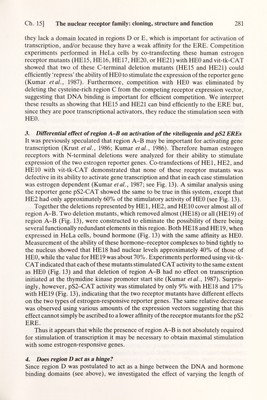
![Ch. 15] The nuclear receptor family: cloning, structure and function 281 they lack a domain located in regions D or E, which is important for activation of transcription, and/or because they have a weak affinity for the ERE. Competition experiments performed in HeLa cells by co-transfecting these human estrogen receptor mutants (HE15, HE16, HE17, HE20, or HE21) with HEO and vit-tk-CAT showed that two of these C-terminal deletion mutants (HE15 and HE21) could efficiently 'repress' the ability of HEO to stimulate the expression of the reporter gene (Kumar et al., 1987). Furthermore, competition with HEO was eliminated by deleting the cysteine-rich region С from the competing receptor expression vector, suggesting that DNA binding is important for efficient competition. We interpret these results as showing that HE15 and HE21 can bind efficiently to the ERE but, since they are poor transcriptional activators, they reduce the stimulation seen with HEO. 3. Diiferential effect of region A-B on activation of the vitellogenin and pS2 EREs It was previously speculated that region A-B may be important for activating gene transcription (Krust et al., 1986; Kumar etat., 1986). Therefore human estrogen receptors with N-terminal deletions were analyzed for their ability to stimulate expression of the two estrogen reporter genes. Co-transfections of HEl, HE2, and НЕЮ with vit-tk-CAT demonstrated that none of these receptor mutants was defective in its ability to activate gene transcription and that in each case stimulation was estrogen dependent (Kumar et al., 1987; see Fig. 13). A similar analysis using the reporter gene pS2-CAT showed the same to be true in this system, except that HE2 had only approximately 60% of the stimulatory activity of HEO (see Fig. 13). Together the deletions represented by HEl, HE2, and НЕЮ cover almost all of region A-B. Two deletion mutants, which removed almost (HE18) or all (HE19) of region A-B (Fig. 13), were constructed to eliminate the possibility of there being several functionally redundant elements in this region. Both HE18 and HE19, when expressed in HeLa cells, bound hormone (Fig. 13) with the same affinity as HEO. Measurement of the ability of these hormone-receptor complexes to bind tightly to the nucleus showed that HE18 had nuclear levels approximately 40% of those of HEO, while the value for HE19 was about 70%. Experiments performed using vit-tk- CAT indicated that each of these mutants stimulated CAT activity to the same extent as HEO (Fig. 13) and that deletion of region A-B had no effect on transcription initiated at the thymidine kinase promoter start site (Kumar etat., 1987). 5ифП8- ingly, however, pS2-CAT activity was stimulated by only 9% with HE18 and 17% with HE19 (Fig. 13), indicating that the two receptor mutants have different effects on the two types of estrogen-responsive reporter genes. The same relative decrease was observed using various amounts of the expression vectors suggesting that this effect cannot simply be ascribed to a lower affinity of the receptor mutants for the pS2 ERE. Thus it appears that while the presence of region A-B is not absolutely required for stimulation of transcription it may be necessary to obtain maximal stimulation with some estrogen-responsive genes. 4. Does region D act as a hinge? Since region D was postulated to act as a hinge between the DNA and hormone binding domains (see above), we investigated the effect of varying the length of](https://iiif.wellcomecollection.org/image/b18029310_0286.JP2/full/800%2C/0/default.jpg)