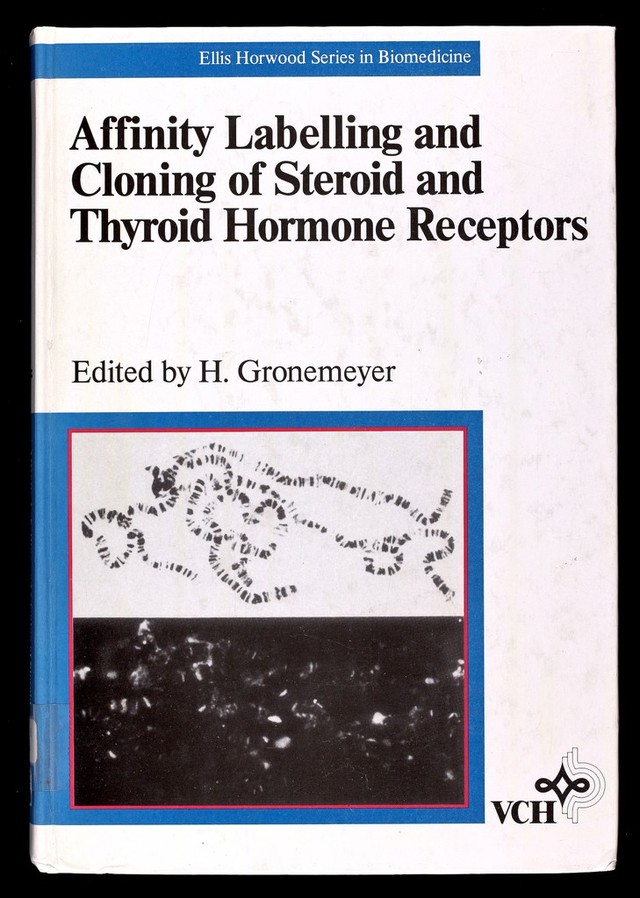
Affinity labelling and cloning of steroid and thyroid hormone receptors / edited by H. Gronemeyer.
- Date:
- [1988]
Licence: Attribution-NonCommercial-NoDerivatives 4.0 International (CC BY-NC-ND 4.0)
Credit: Affinity labelling and cloning of steroid and thyroid hormone receptors / edited by H. Gronemeyer. Source: Wellcome Collection.
41/332 page 37
![Ch. 2] Glucocorticoid receptor 37 С. Labeling of Yb-glutathione-iS-transferase (Homma and Listowsky, 1985) Cytosol from livers of male Sprague-Dawley rats (175-200 g) (105 000 g superna- tants) was prepared in 10 mM Tris-HCl+l.OmM EDTA, pH8.0 (Tris-EDTA) buffer. Cytosol preparations (3 ml) were adjusted to a protein concentration of 38 mg/ml with Tris-EDTA buffer and incubated with 10 (x\ of [^H]Dex-Mes at a final concentration of 4xlO~^M. Some cytosol preparations were diluted 1:100 in the Tris-EDTA buffer and labeled with [^H]Dex-Mes in the presence or absence of 1 дМ dexamethasone, which revealed dexamethasone competition of [^H]Dex-Mes binding-labeling. Reactions were allowed to proceed for 12 h at 4°C. VI. ELECTROPHILIC AFFINITY LABELING OF PROTEIN BY CORTISOL AND DEXAMETHASONE It is generally accepted that Cortisol and dexamethasone bind to steroid receptors, and proteins in general, in a completely reversible manner to give only non-covalent complexes. However, under certain non-photochemical conditions, covalent ster¬ oid-protein adducts have been observed. A. Labeling of BSA via Heyns rearrangement (Bucala et al., 1982; Bucala et al., 1986) 130 pmol of pH]cortisol was placed into tubes and evaporated under nitrogen. The steroid was dissolved in 60 ß\ of ethanol, followed by the addition of 0.54 ml of 50 mM potassium phosphate buffer (pH 7.4) and 0.4 ml of a solution of human serum albumin (100 mg/ml) dissolved in 50 mM potassium phosphate buffer, pH7.4, containing 10% (v/v) ethanol. The final incubation mixture contained 0.13/хМ steroid and 40 mg/ml of albumin. At time zero, the mixtures were transferred from 0°C to a 37°C water bath. At various times, 0.1 ml aliquots were removed, placed inside dialysis tubing (Mr cutoff, 12 000-14 ООО) and dialyzed for 24 h against 21 of 50 mM potassium phosphate (pH7.4)-10% ethanol. The remaining unreacted steroid was removed by chromatography over a column (1 cm x 29 cm) of Sephadex G-lOO, which was equilibrated with 50 nM potassium phosphate (pH7.4)-10% ethanol. The ñow rate was 3 ml/h, and the protein eluate was monitored by absorbance at 280 nm. Fractions (0.5 ml) were collected and the moment of radioac¬ tivity was determined by scintillation counting. After 48 h of incubation at 37°C, about 30% of the added Cortisol was bound to albumin. Similar reactions of [^H]dexamethasone at 0.4 дМ with BSA under shghtly different conditions (BSA concentration, 0.6 mg/ml; total EtOH = 1.5% (v/v); temperature, 2ГС; time 0-5 days) were analyzed by SDS-polyacrylamide gel electrophoresis. Here much less covalent attachment was observed in a reaction that was pH dependent (—0.14% labeling after 5 days at pH 7.0; ~0.57% labeling after 5 days at pH 8.8) and independent of the free thiol content of the BSA (S. S. Simons, Jr., unpublished results). VIL SDS-POLYACRYLAMIDE GEL ANALYSIS OF AFFINITY LABELED PROTEINS The non-specific binding, and covalent labeling, of crude receptor preparations with [^H]Dex-Mes increases dramatically with higher concentrations of Dex-Mes. Also,](https://iiif.wellcomecollection.org/image/b18029310_0042.JP2/full/800%2C/0/default.jpg)


 No text description is available for this image
 No text description is available for this image
 No text description is available for this image