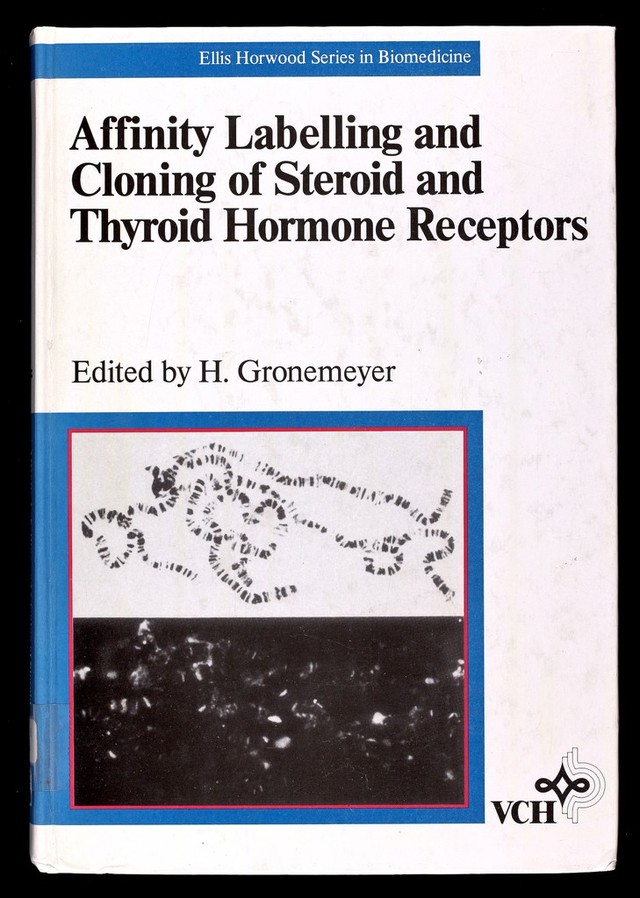
Affinity labelling and cloning of steroid and thyroid hormone receptors / edited by H. Gronemeyer.
- Date:
- [1988]
Licence: Attribution-NonCommercial-NoDerivatives 4.0 International (CC BY-NC-ND 4.0)
Credit: Affinity labelling and cloning of steroid and thyroid hormone receptors / edited by H. Gronemeyer. Source: Wellcome Collection.
43/332 page 39
![Ch. 2] Glucocorticoid receptor 39 60°C with a sheet of dialysis membrane backing (Bio-Rad) directly over the gel to prevent cracking, and fluorographed for 7-12 days with Kodak X-OMAT XAR-5 film. The positions of the non-radioactive molecular weight markers were visualized on the fluorographs by overlaying the dried gel with a phosphorescent marker (UltEmit, New England Nuclear). For the slice and counting of gels, gels were sliced (Bio-Rad gel sheer), digested in 0.5 ml of 30% hydrogen peroxide at 60°C for about 4 h, and counted in 5 ml of Hydrofluor (National Diagnostics). C. Non-equilibrium pH gradient electrophoresis (NEPHGE) of pH]Dex-Mes labeled-receptors (Smith and Harmon, 1985, 1987) Samples to be subjected to NEPHGE were diluted with an equal volume of 2D sample solution (9.5 M urea, 2.0% ampholytes (1.6% pH 5-8, 0.4% pH 3-10), 5% ß-mercaptoethanol, 2.0% NP-40). NEPHGE was performed, with minor modifica¬ tions, by the method of O'Farrell et al. (1977). Polyacrylamide gels (3% with a 1:17.7 ratio of bis-acrylamide to acrylamide) containing 9.2 M urea, 2.0% NP-40, and a mixture of 1.6% pH5-7 and 0.4% pH3-10 ampholytes were cast in glass tubes (125 mmx3 mm) to a height of 11.5 cm. Electrophoresis of samples was performed on non-pre-electrophoresed gels from anode to cathode at 400 V for 2-12 h followed by a final 30 min of electrophoresis at 800 V. Isoelectric equilibrium was achieved after 6 h. The pH gradient formed by ampholyte migration during NEPHGE was mea¬ sured immediately after electrophoresis. Gels were sliced into 6 mm sections and incubated in distilled H2O for 30 min. The pH of the water was then determined. Immediately after electrophoresis, NEPHGE gels were sliced into 6 mm sections and incubated for 18 h with 0.5 ml of Protosol at 37°C. Acetic acid (17 /Л) was added to neutralize the solution, and scintillation fluid was then added for quantitation of radioactivity. D. Isoelectric focusing of [^H]Dex-Mes labeled receptors on agarose gels (Danze et al., 1987) Agarose gel slabs (0.5 mmx245 mmx 110mm) were prepared 1 or 2 days before use according to the LKB instruction manual 1818A. The gel composition was 0.8% (w/ v) isogel agarose EF, 0.5% (v/v) glycerol and 0.6% (v/v) ampholines (pH range 3.5-9.5). The slab was placed in an LKB multiphor 2117 apparatus connected to an LKB 2103 power supply. Samples (0.02 ml) were applied 1.5 cm from the cathode on a paper sample applicator. The gel was cooled at 4°C throughout the experiment and the running conditions were as follows: current and power unlimited, voltage going from 500 to 1500 V. After a 40 min run, the pH gradient was estimated along a control track which had been loaded with a sample of the low pi calibration kit (p/= 2.5-6.5; Pharmacia) and then stained with Coomassie brilliant blue G250. Tracks containing the labeled receptor samples were either cut into 1 mm shces for radioactivity counting or used for further chromatographic characterization. In some experiments a rather large amount of complex was applied nearly right across the agarose gel. After focusing, the position of the labeled receptor was checked on a control track and the bulk of the agarose corresponding to this position was cut out. The focused receptor could be eluted from the agarose for subsequent biochemical characterization (e.g. binding to DNA-cellulose columns).](https://iiif.wellcomecollection.org/image/b18029310_0044.JP2/full/800%2C/0/default.jpg)


 No text description is available for this image
 No text description is available for this image
 No text description is available for this image