Orientation of the nitro- and arylazo-glyoxalines. Fission of the glyoxalone nucleus / by Robert George Fargher.
- Fargher, Robert George.
- Date:
- [1920?]
Licence: In copyright
Credit: Orientation of the nitro- and arylazo-glyoxalines. Fission of the glyoxalone nucleus / by Robert George Fargher. Source: Wellcome Collection.
2/14 page 669
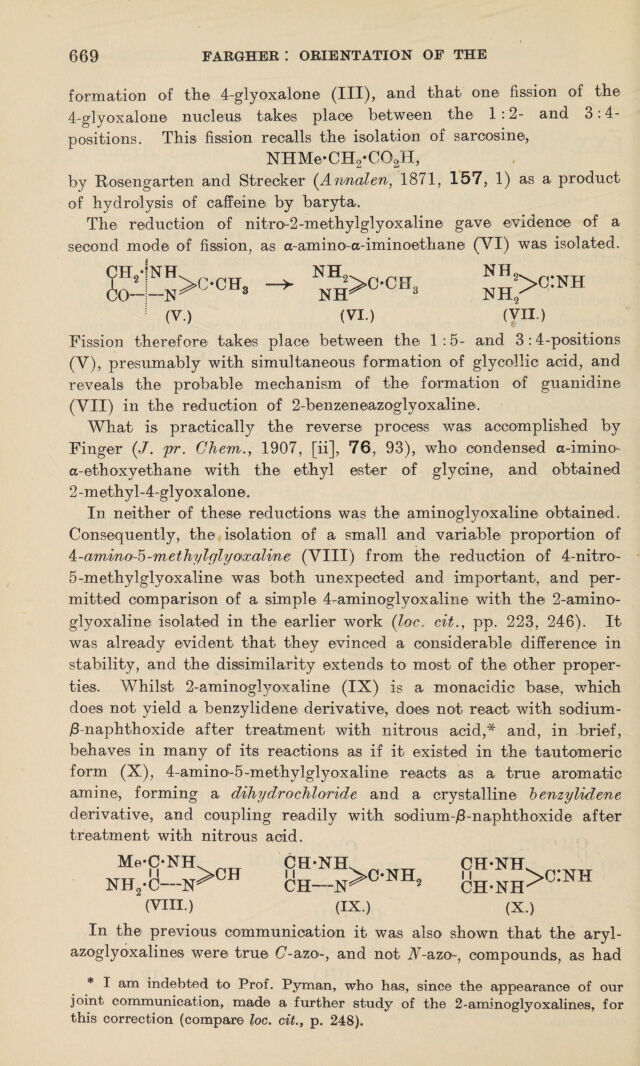
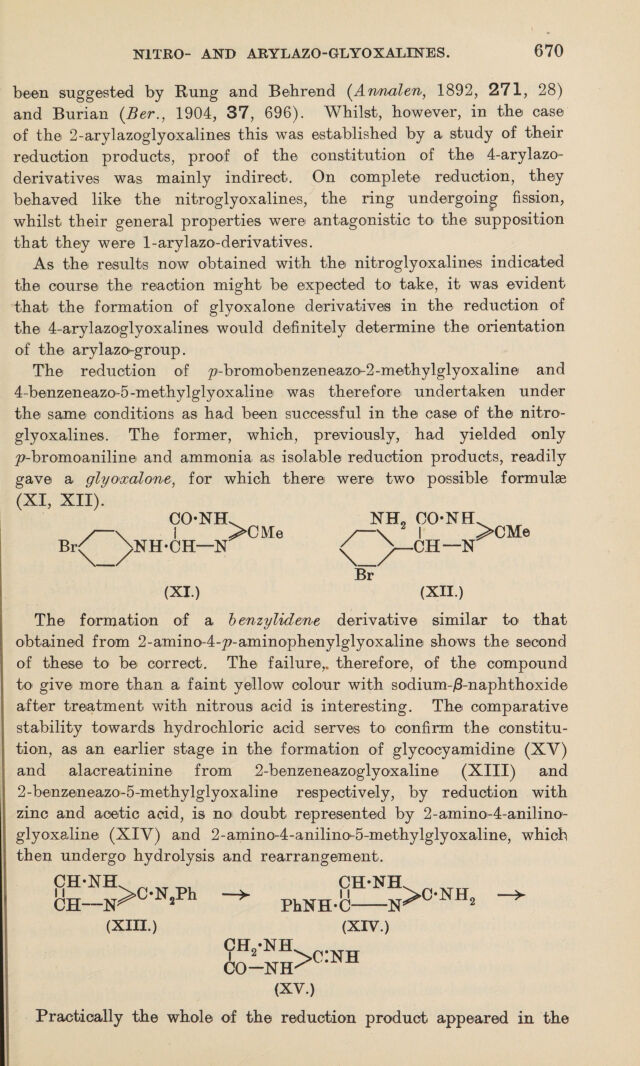
![formation of the 4-glyoxalone (III), and that one fission of the 4-glyoxal°ne nucleus takes place between the 1 :2- and 3:4- positions. This fission recalls the isolation of sarcosine, NHMe-CH2-C02H, by Rosengarhen and Streaker (Armed en, 1871, 157, 1) as a product of hydrolysis of caffeine by baryta. The reduction of nitro-2-methylglyoxaline gave evidence of a second mode of fission, as a-amino-a-iminoethane (VI) was isolated. NH, CH2*E>oohj Ao— -N: (V.) NH>C'CH3 (VI.) NH !>c:nh (VII.) Fission therefore takes place between the 1 :5- and 3:4-positions (V), presumably with simultaneous formation of glycollie acid, and reveals the probable mechanism of the formation of guanidine (VII) in the reduction of 2-benzeneazoglyoxaline. What is practically the reverse process was accomplished by Finger (/. pr. Ghem., 1907, [ii], 76, 93), who condensed a-imino- a-ethoxyethane with the ethyl ester of glycine, and obtained 2-methyl-4-glyoxalone. In neither of these reductions was the aminoglyoxaline obtained. Consequently, the isolation of a small and variable proportion of ^-amino'-b-methylglyoxaline (VIII) from the reduction of 4-nitro- 5-methylglyoxaline was both unexpected and important, and per¬ mitted comparison of a simple 4-aminoglyoxaline with the 2-amino- glyoxaline isolated in the earlier work (loc. cit., pp. 223, 246). It was already evident that they evinced a considerable difference in stability, and the dissimilarity extends to most of the other proper¬ ties, Whilst 2-aminoglyoxaline (IX) is a monacidic base, which does not yield a benzylidene derivative, does not react with sodium- /3-naphthoxide after treatment with nitrous acid,* and, in brief, behaves in many of its reactions as if it existed in the tautomeric form (X), 4-amino-5-methylglyoxaline reacts as a true aromatic amine, forming a dihydro chloride and a crystalline benzylidene derivative, and coupling readily with sodium-/3-naphthoxide after treatment with nitrous acid. Me-C-NH NH2*C—N (VIII.) >CH CH-NR „ CH___n>c*NHs (IX.) CH*NH. 11 NC.NH (X.) In the previous communication it was also shown that the aryl- azoglyoxalines were true C-azo-, and not N-azou, compounds, as had * I am indebted to Prof. Pyman, who has, since the appearance of our joint communication, made a further study of the 2-aminoglyoxalines, for this correction (compare loc. cit., p. 248).](https://iiif.wellcomecollection.org/image/b30622621_0002.jp2/full/800%2C/0/default.jpg)