Studies on Rocky Mountain spotted fever / U.S. Treasury Department, Public Health Service.
- Date:
- [1930]
Licence: Public Domain Mark
Credit: Studies on Rocky Mountain spotted fever / U.S. Treasury Department, Public Health Service. Source: Wellcome Collection.
57/150 page 41
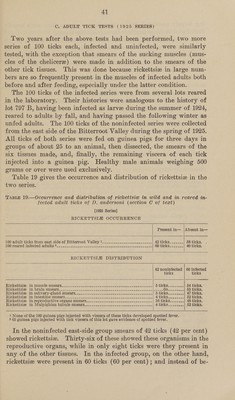
![C. ADULT TICK TESTS (1925 SERIES) Two years after the above tests had been performed, two more series of 100 ticks each, infected and uninfected, were similarly tested, with the exception that smears of the sucking muscles (mus- cles of the cheliceree) were made in addition to the smears of the other tick tissues. This was done because rickettsize in large num- bers are so frequently present in the muscles of infected adults both before and after feeding, espécially under the latter condition. The 100 ticks of the infected series were from several lots reared in the laboratory. Their histories were analogous to the history of lot 797 B, having been infected as larvee during the summer of 1924, reared to adults by fall, and having passed the following winter as unfed adults. The 100 ticks of the noninfected series were collected from the east side of the Bitterroot Valley during the spring of 1925. All ticks of both series were fed on guinea pigs for three days in groups of about 25 to an animal, then dissected, the smears of the six tissues made, and, finally, the remaining viscera of each tick injected into a guinea pig. Healthy male animals weighing 500 grams or over were used exclusively. Table 19 gives the occurrence and distribution of rickettsise in the two series. TABLE 19.—Occurrence and distribution of rickettsie in wild and in reared in- fected adult ticks of D. andersoni (section C of text) [1925 Series] RICKETTSIZ OCCURRENCE Present in— |Absent in— 100 adult ticks from east side of Bitterroot Valley 1...__........-.------_--_- ADMICKSs Sane 58 ticks. . 100 rearedsinfectedsadults 222 2 ors ee ee en ce i Se Lee 60 ticks_....-- 40 ticks. RICKETTSIA DISTRIBUTION 42 noninfected | 60 infected ticks icks Rulekcettsicn. imiMtisele smears. Noe ee oe ee ak ce Se ee §- ticks. eek 54 ticks. RACKSLESISS. Ill Tal Mesa eae ee tes Sa eee Eee io Bee SE CG Ko eres ee eae 55 ticks. Hickoettsics im salivary-plandssmieagng: oe ee es a et er ee DiblekSu ease 47 ticks. EICKOLSles INP hitLOSbihG SIMGATS 28 eo. Oe oe oe ee es oeeteeeee 4A TICKS i222 oso 52 ticks. RiIGKSttsise: INiFOproducbive OLSAns SMearse. 4 soos oo Ceo Lee SOMICKS He Tal gee 48 ticks. Ricketisies in Malpighian tubule smears... -:222:-- ee soe oe on so ee ee AGiOkSe 2 shee ao 52 ticks. 1 None of the 100 guinea pigs injected with viscera of these ticks developed spotted fever. 265 guinea pigs injected with tick viscera of this lot gave evidence cf spotted fever. In the noninfected east-side group smears of 42 ticks (42 per cent) showed rickettsie. Thirty-six of these showed these organisms in the reproductive organs, while in only eight ticks were they present in any of the other tissues. In the infected group, on the other hand, rickettsize were present in 60 ticks (60 per cent) ; and instead of be-](https://iiif.wellcomecollection.org/image/b32174962_0057.jp2/full/800%2C/0/default.jpg)


 No text description is available for this image
 No text description is available for this image
 No text description is available for this image