Lectures on the American eclectic system of surgery / by Benjamin L. Hill.
- Hill, B. L. (Benjamin L.)
- Date:
- 1850
Licence: Public Domain Mark
Credit: Lectures on the American eclectic system of surgery / by Benjamin L. Hill. Source: Wellcome Collection.
Provider: This material has been provided by the University of Massachusetts Medical School, Lamar Soutter Library, through the Medical Heritage Library. The original may be consulted at the Lamar Soutter Library at the University of Massachusetts Medical School.
602/684 (page 596)
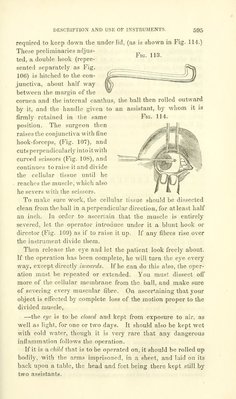
![As it regards the result of the operation, it may be stated as generally successful,—though the defect occasionally recurs. The advantage is not always at first very perceptible,—the reciprocal action of the muscles requiring time for re-adjust- ment. The temporary loss of one muscle will cause the eye- ball to project a little more than natural, but not so much as to occasion any appreciable deformity. In most cases the ultimate improvement of sight or looks is very satisfactory. [For a very interesting dissertation on Strabismus, I would refer the reader to a little volume published by Prof. Hamilton, of Buffalo, in 1845.] LECTURE LVII. OTHER OPERATIONS ON OR ABOUT THE EYES. All the qualities of a good operator (page 443) are peculiarly requisite in ophthalmic surgery, particularly his having good eyes and a steady hand. The anatomy and surgery of this complex part of the organism must, moreover, have been made a special study; one should have operated on, as well as dissected, thousands of eyes, (luckily, hogs eyes will answer the purpose of learning on as well as any.) The OPHTHALMIC CASE should contain at least the following instruments:—The eye-forceps, with interlocking points (Fig. 107); a small spatula and scoop, both of silver; the fine eye- hooks (Fig. 106); Scarpa's curved needle (Fig. 119), and cataract knife (Fig. 122-3); the director or curette (Fig. 109)— to which list I have added the curved spring-wire speculum,* (see Figs. 112 and 105, and page 593 and 594.) * This instrument I use in all operations upon the eye, where pressure is not inadmissible. Having noticed the difficulties of eye-operations, from the mobility of the ball, and the pain caused the patient by imperfect attempts at fixing it, I several years ago had an instrument constructed similar to the one referred to, but with one curve less in it, which answered the principal object effectually, but left the assistant's hand somewhat in the way,—though much less so than the fingers directly on the lid. With the assistance of Mr. Max. Wocher, I had the present instrument constructed about two years ago,—since which time a large number](https://iiif.wellcomecollection.org/image/b21197349_0602.jp2/full/800%2C/0/default.jpg)