Dr. Blaxall's report to the Local Government Board on an epidemic of diphtheria in the rural sanitary district of Sculcoates in the county of York, and upon the sanitary condition of the infected localities / [F.H. Blaxall].
- Blaxall, F. H.
- Date:
- 1878
Licence: Public Domain Mark
Credit: Dr. Blaxall's report to the Local Government Board on an epidemic of diphtheria in the rural sanitary district of Sculcoates in the county of York, and upon the sanitary condition of the infected localities / [F.H. Blaxall]. Source: Wellcome Collection.
6/14 page 6
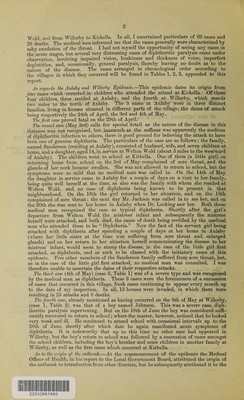
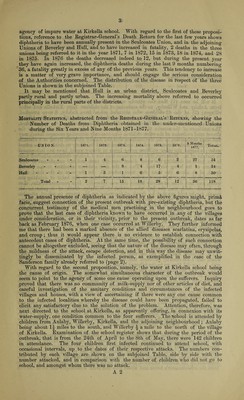
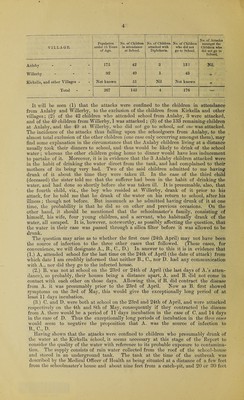
![may be mentioned that in one family, consisting of nine members, six children were attacked and three died (Cases 3 to 8, Table 2). In another family, consisting of six members, five were attacked and two died (Cases 11 to 15, Table 3). In a third family, consisting of four members, all were attacked, the father, mother, and one child dying, and the other child remaining a victim to diphtheritic paralysis (Cases 23 to 26, Table 3). In the adjoining house there lived the father, mother, sister, and niece of the above (Case 25), the two latter were attacked (Cases 21 and 22), one case proving fatal and the other remaining afflicted with paralysis. This family susceptibility was perhaps more specially manifested in the case of three brothers, all married and living with their respective families in houses widely apart. Diphtheria invaded each of the three dwellings, attacking in the one house the husband and four children, one case proving fatal (Cases 4, 16, 19, 20, Table 3). In another house the husband and one child (mild cases), and in the third house two children, both cases fatal (Cases 2 and 3, Table 3). Upon inquiry into the history of these cases it was found that the three infected families had not been thrown more into personal contact with each other than with other families living in the neighbourhood who escaped. The schools commonly playing an important part in the spread of infectious disease through the bringing together of infected and healthy children, it should be stated in respect of the school at Kirkella that three cases are referable to this agency, and that these three cases proving fresh centres of infection, resulted in all in 10 cases and six deaths. The general particulars of the several cases are included in the Chronological Tables appended to this Report; it may, therefore, suffice here to give examples of such of the cases as present peculiar features of interest. Examples.—Case 1, Table 2 (Willerby).—Boy, named Johnson, date of attack, 8th of May. To recapitulate the particulars already given on page 2. This case was characterised by typical symptoms followed by diphtheritic paralysis, but on the 18th of June the boy was considered sufficiently recovered to return to school, when the master observed he looked very weak and ill. He continued to attend school, though somewhat irregularly, up to the 26th of June, when he ceased attendance altogether, and a few days afterwards again manifested acute] symptoms of diphtheria. In con¬ nexion with this second attack, it must be borne in mind that the boy admitted having occasionally drunk of the school water after his return to school on the 18th of June. It therefore becomes an open question whether, through any peculiar suscepti¬ bility, this second illness was associated with the fact of his having drunk of the water. For my own part I attach little importance to the circumstance, thinking it probable the second illness was a relapse, due to the boy having gone back to school in a very debilitated condition, and observing further that, at this later period, there was no reason for connecting the school water with the existence of the disease. Up to this time there had been no other case of diphtheria in Willerby, but simultaneously with the boy’s second illness (on or about the 30th of June) his brother was attacked, and died on the 20th of July (Case 2, Table 2). He attended Kirkella school 28th and 29th of June. Case 3, Table 2.—Little girl, named Pluves, attacked 3rd of July, died on the 12th, attended school at Kirkella, notably on the 28th and 29th of June, and probably con¬ tracted the disease from walking there in company with the boy Johnson, in whom the disease was then in the incubative stage (see above, Case 2). Five other cases occurred in the Pluves family, two proving fatal (Cases 4 to 8, Table 2). One of the infected children continued to attend school up to the date of her attack, and thus it would seem was the means of introducing the disease into Kirkella (see following cases). Cases 9 and 10, Table 2 (Kirkella).—Two little girls, named Mowforth and Batty, living in houses widely apart, both attacked on the 10th of July. One case (Mowforth) proving fatal on the 28th of July, the other (Batty) on the 2nd of September of diphtheritic paralysis. These children apparently contracted the disease from personal contact with the little girl Pluves (Case 4, Table 2), it being in evidence that one of the children sat next to Pluves at school on the 5th and 6th July, and the other walked to school in company with her. The sister of Pluves was at the time lying at home dangerously ill with diphtheria, and she herself was attacked on the lltli of July, so probably was in the incubative stage on the 6th of July when the little girls were in contact with her. Case 11, Table 2.—Girl aged 4, attacked on 16th September, died on 28th of September, apparently contracted the disease from going on the 5th of September to see the dead body of little Batty (Case 10, Table 2), as there was no evidence of her having been exposed to infection in any other way, nor was there any other case of diphtheria present at that time in the village./ Supposing the disease to have been thus](https://iiif.wellcomecollection.org/image/b30557859_0006.jp2/full/800%2C/0/default.jpg)