Observations on the habits and natural surroundings of insects made during the 'Skeat expedition' to the Malay peninsula, 1899-1900 / by Nelson Annandale.
- Nelson Annandale
- Date:
- 1900
Licence: In copyright
Credit: Observations on the habits and natural surroundings of insects made during the 'Skeat expedition' to the Malay peninsula, 1899-1900 / by Nelson Annandale. Source: Wellcome Collection.
Provider: This material has been provided by The Royal College of Surgeons of England. The original may be consulted at The Royal College of Surgeons of England.
8/36 page 842
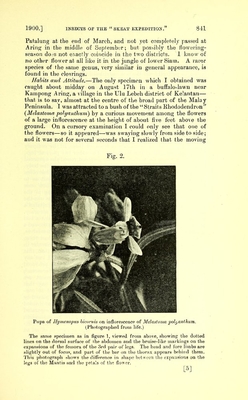
![flower was not a flower at all, but a Mantis. Even then it betrayed itself by turning round and staring me in the face in the manner characteristic of the Mautidae. When I held the branch on which the insect had established itself in my hand, I could not tell exactly where animal tissue commenced and where flower ended, so perfectly was the one assimilated to the other, not only in colour but in surface texture, and perhaps even to some degree in structure. The Mantis had ensconced itself in the very centre of the inflorescence, a position which it never assumed in the three days during which it remained alive in my hands : it will be noticed in the iigures (pp. 840, 841), which are from photographs taken from life at Aring, that the insect is clinging to the edge of a bunch of flowers. The attitude which it adopted did not change with its position in the inflorescence. In all cases, so long as the insect was on the watch for prey, the abdomen was bent backv\ards until its dorsal surface almost touched that of the thorax. The head and thorax were held upright, and the fore limbs in front of them, in the ordinary “ praying ” attitude of the Mantidse. The other two pairs of legs, by which it clung to the flowers, were disposed round the upturned abdomen, more or less at right angles to the main axis of the body. Sometimes this was the same as that of the inflorescence, but often it was at an angle to it; for the Mantis seemed indifferent as to whether its head or one of its sides was uppermost. When once a position had been taken up, it was never changed so long as the insect remained on that particular inflorescence. Perfect as was the concealment thus effected, 1 cannot say that the Mantis imitated a single flower or part of a single flower with any great accuracy. Perhaps the upturned abdomen might be taken to represent a bud not yet opened, while the darker expansions on the femora showed a greater resemblance to petals which had already unfurled themselves. The petals of Melastoma^ how'ever, are more elongated than these structures on the legs of the Mantis, which are almost circular in shape, though their diameter is as great as, if not greater than, that of the floral structures which they represent. What I can say with certainty is, that a most marvellous resemblance is produced between the insect Hymenopus bicornis and part of an inflorescence of Melasioma polyanthum when the flower and the insect are combined, as they sometimes are in nature. I cannot say that they are always found together. An interesting point in con- nection with this simulation of the flowers is the part played by the green bar across the thorax of the Mantis. This bar divided the prothorax from the rest of the body, and apparently separated the insect into two parts, u hich appeared to have no connection wdth one another on the inflorescence. In no ordinary in- florescence of this plant are the flowers large enough to afford an expanse of uniform coloration of the size of Hymenopus. During an unsuccessful search for further specimens in the buffalo-lawn at Aring, the Mantis w’as placed, together wuth the inflorescence to w hich it still clung, in a large box lined with dead leaves. On the lid being taken off from this, after about half an [«]](https://iiif.wellcomecollection.org/image/b22406451_0010.jp2/full/800%2C/0/default.jpg)



 No text description is available for this image
 No text description is available for this image
 No text description is available for this image