Observations on the habits and natural surroundings of insects made during the 'Skeat expedition' to the Malay peninsula, 1899-1900 / by Nelson Annandale.
- Nelson Annandale
- Date:
- 1900
Licence: In copyright
Credit: Observations on the habits and natural surroundings of insects made during the 'Skeat expedition' to the Malay peninsula, 1899-1900 / by Nelson Annandale. Source: Wellcome Collection.
Provider: This material has been provided by The Royal College of Surgeons of England. The original may be consulted at The Royal College of Surgeons of England.
9/36 page 843
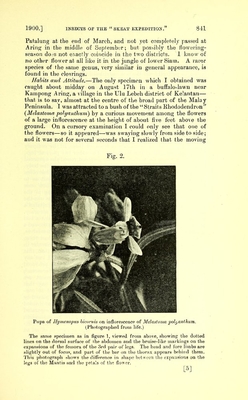
![liour’s inter'al, it uas found that the insect had duserted I he flowers and \N as sitting quite still among the leaves at t he bottom of the box. Though its attitude \'as esseutially the same as before, its whole appearance was now completely changed ; for it no longer resembled the flowers among which it had been found except in the most remote degree, but appeared rather to simulate an orchid fallen upon the ground. The brown lines on the upper surface of the abdomen, which had before been concealed among the petals of the flowers, became conspicuous from many points of view, now that the body was seen from above. Converging as they did towards the junction with the thorax, they bore no slight likeness to the “honey-guides” of many orchids. The darker transverse bars seen in the shadow cast by the head and thorax gave an idea of hollowness such as might be expected round the nectaries ; while the abdomen itself represented the labellum, and the limbs the other petals of the orchid. The head and thorax took the place of the stamen and anthers, their resemblance to which was greatly increased by the horn-shaped eyes; and even the green bar on the thorax had a new part to play, for on not a few orchids there is just such a band at the base of this part of the flower. No change of colour aided the change of appearance. The Mantis remained among the dead leaves for the rest of the day of its capture and for the night which followed, without altering its tint or losing anything of its brilliancy. I do not know of any specific orchid which it may have simulated; orchids of sufficient size and brilliancy of colour are rare, if not unknown, in lower Siam. Early the next morning the Mantis v\ as placed on a packing- case in the open air, near a large branch of the “ Ehododendron ” fixed upright in a natural position. It deliberately walked towards the branch, swaying its whole body from side to side as it pro- gressed, and commenced to climb one of the twigs. This twig, however, bore only green buds and unripe fruit. When the ManTs reached the tip of the twig and found no flowers, it re- mained still for a few seconds, and then turned and descended with the same staggering gait. It proceeded to climb anotln r twdg. This also bore no flowers. The Mantis descended from it and mounted a third twig, which was topped by a large bunch of full-blown blossoms. To these it clung by means of the claws of the two posterior pairs of limbs. Eor a few minutes it remained perfectly still, and then began swaying its body from side to side, as it had done while v^aiking. (It was only during this brief interval of rest that I was able to secure a photograph, for in a tropical climate so damp as that of low^er Siam instantaneous photography is never satisfactory. The light, in spite of its apparent intensity, is very feebly actinic, and the moisture of the atmosphere combined with the heat makes it impossible to keep “rapid” plates for any length of time.) While the body of the Mantis v as in motion the fine hair-like antennae were also in con- stant agitation, sometimes being held upright, sometimes stretched out like horns, and sometimes Iving back along the thorax. [7]](https://iiif.wellcomecollection.org/image/b22406451_0011.jp2/full/800%2C/0/default.jpg)



 No text description is available for this image
 No text description is available for this image
 No text description is available for this image