An investigation into the functions of the occipital and temporal lobes of the monkey's brain / by Sanger Brown and E.A. Schäfer.
- Sanger Brown
- Date:
- 1888
Licence: Public Domain Mark
Credit: An investigation into the functions of the occipital and temporal lobes of the monkey's brain / by Sanger Brown and E.A. Schäfer. Source: Wellcome Collection.
Provider: This material has been provided by The Royal College of Surgeons of England. The original may be consulted at The Royal College of Surgeons of England.
25/34 page 325
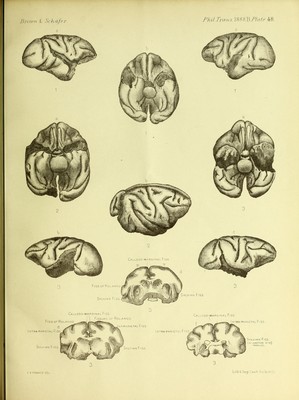
![operation and when still drowsy from the prolonged influence of the anaesthetic, and follow with the head and eyes the direction of footsteps along a corridor outside the room in which they are confined. Some of these animals we have had under obser- vation for many months; they have been seen and tested by many people, and the absence of the gyrus has been attested by 'postmortem examination, Ferrier and Yeo# have published a similar case of destruction of the superior temporal gyrus on both sides of the brain with a result contrary to those which we have obtained. In their case the Monkey was apparently stone-deaf. It reacted to no sounds,! not even to the report of a pistol. The ears did not even twitch at unusual sounds, as they frequently do in Monkeys. It was examined independently by competent observers, and was exhibited at the International Medical Congress of 1881 to the Physiological Section, and no evidence of hearing even the report of a pistol could be obtained. The animal was kept under observation for thirteen months, and showed during all that time no clear evidence of hearing. There is no doubt that Ferrier was justified by the result of this experiment in inferring that the cerebral localisation of auditory impressions is to be looked for in the superior temporal gyri. | But, to our thinking, he was not justified in assuming such localisation without further evidence than that afforded by this single experiment. The matter was of sufficient importance to call for a repetition of the lesion in other Monkeys ; and had this been done by him we have no doubt, in view of our own expe- riments, that Ferrier would have seen reason to modify his too rapid conclusion. In six different Monkeys we have established this lesion, with or without involving other parts of the lobe, and in none of them has hearing been abolished, or even permanently diminished in acuteness,§ This discrepancy between the experiment of Ferrier and Yeo and these results of our own cannot be explained by assuming that the lesion was more extensive in their case than in ours. On the contrary, although in one or two of our animals a minute portion of the gyrus was found to have been left, in all without exception, as may be seen by comparing the respective figures, the removal was much more extensive and complete than in the Monkey operated on by Ferrier and Yeo, in which, especially upon the right side, a very noticeable amount of the covolution remains (see the figs, of sections across the brain in their paper already * Op. cit., Experiment 13 ; and Ferrier, 1 Functions of the Brain,’ pp. 309, 310. t This statement is, however, not unmodified. “ Occasionally a doubt was raised as to whether the absence of reaction to sounds was absolute.” Ferrier, loc. cit., p. 310. t This opinion must be modified since the publication of the notes of this case in a recent number of 1 Brain.’ (Ferrier : “ Schafer on the Temporal Occipital Lobes.” 4 Brain,’ April, 1888, pp. 13-16.) From these it appears that the Monkey frequently reacted to auditory impressions. The subject will, however, be fully discussed by me in the next number of ‘Brain.’—[E.A.S., June 18, 1888.] § Dr. Ferrier was good enough to assist us on several occasions in investigating our animals, especially some of those with a double superior temporal lesion; and in all of those which we submitted to him, with one exception, he frankly acknowledged that the perception of auditory impressions](https://iiif.wellcomecollection.org/image/b22289124_0027.jp2/full/800%2C/0/default.jpg)
 No text description is available for this image
 No text description is available for this image
 No text description is available for this image