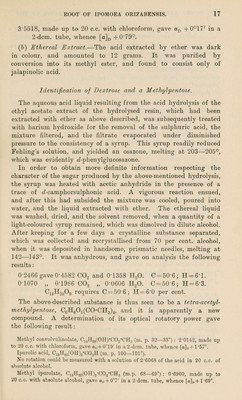
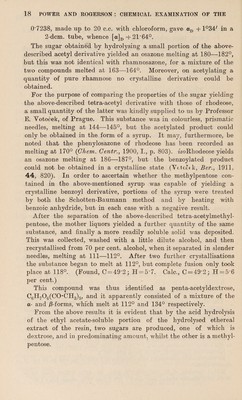
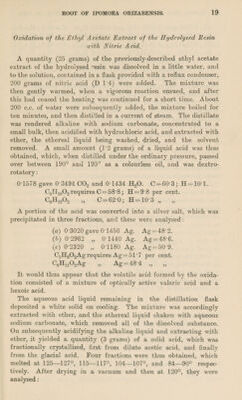
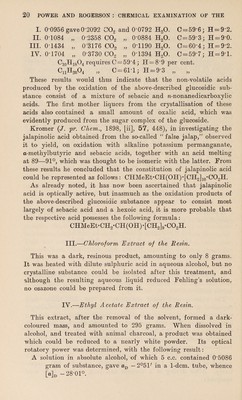
Chemical examination of the root of ipomoea orizabensis / by Frederick B. Power and Harold Rogerson.
- Frederick Belding Power
- Date:
- [1912?]
Licence: In copyright
Credit: Chemical examination of the root of ipomoea orizabensis / by Frederick B. Power and Harold Rogerson. Source: Wellcome Collection.
24/30 (page 22)
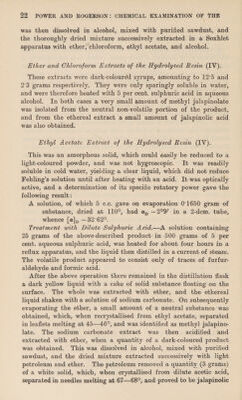
![was then dissolved in alcohol, mixed with purified sawdust, and the thoroughly dried mixture successively extracted in a Soxhlet apparatus with ether ^chloroform, ethyl acetate, and alcohol. Ether and Chloroform Extracts of the Hydrolysed Resin (IV). These extracts were dark-coloure'd syrups, amounting to 12-5 and 2‘3 grams respectively. They were only sparingly soluble in water, and were therefore heated with 5 per cent, sulphuric acid in aqueous alcohol. In both cases a very small amount of methyl jalapinolate was isolated from the neutral non-volatile portion of the product, and from the ethereal extract a small amount of jalapinolic acid was also obtained. Ethyl Acetate Extract of the Hydrolysed Resin (IV). This was an amorphous solid, which could easily be reduced to a light-coloured powder, and was not hygroscopic. It was readily soluble in cold water, yielding a clear liquid, which did not reduce Fehling’s solution until after heating with an acid. It was optically active, and a determination of its specific rotatory power gave the following result: A solution, of which 5 c.c. gave on evaporation 0‘1650 gram of substance, dried at 110°, had aD — 2°9/ in a 2-dcm. tube, whence [a]D —32‘62°. Treatment with Dilute Sulphuric Acid.—A solution containing 25 grams of the above-described product in 500 grams of 5 per cent, aqueous sulphuric acid, was heated for about four hours in a reflux apparatus, and the liquid then distilled in a current of steam. The volatile product appeared to consist only of traces of furfur- aldehyde and formic acid. After the above operation there remained in the distillation flask a dark yellow liquid with a cake of solid substance floating on the surface. The whole was extracted with ether, and the ethereal liquid shaken with a solution of sodium carbonate. On subsequently evaporating the ether, a small amount of a neutral substance was obtained, which, when recrystaliised from ethyl acetate, separated in leaflets melting at 45—46°, and was identified as methyl jalapino¬ late. The sodium carbonate extract was then acidified and extracted with ether, when a quantity of a dark-coloured product was obtained. This was dissolved in alcohol, mixed with purified sawdust, and the dried mixture extracted successively with light petroleum and ether. The petroleum removed a quantity (3 grams) of a white solid, which, when crystallised from dilute acetic acid, separated in needles melting at 67—68°, and proved to be jalapinolic](https://iiif.wellcomecollection.org/image/b30618381_0024.jp2/full/800%2C/0/default.jpg)