Chemical examination of the root of ipomoea orizabensis / by Frederick B. Power and Harold Rogerson.
- Frederick Belding Power
- Date:
- [1912?]
Licence: In copyright
Credit: Chemical examination of the root of ipomoea orizabensis / by Frederick B. Power and Harold Rogerson. Source: Wellcome Collection.
4/30 (page 2)
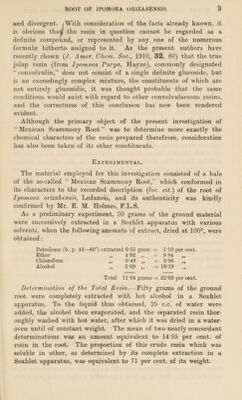
![{Annalen, 1855, 95, 129), the last-mentioned author having given to the resin from Ipomoea orizabensis the name “ jalapin ” * (“ jalappin”), whilst the resin of jalap, or the portion of the latter insoluble in ether, was designated “ convolvulin.” To the so-called “ jalapin,”, the glucosidic character of which was recog¬ nised, Mayer assigned the formula C34H56016. He stated that by the action of alkalis it is converted into “jalapic acid,” C34H60O18, a yellow, amorphous mass, which is readily soluble in water or alcohol, and that on heating either jalapin or jalapic acid with dilute acids they are resolved into sugar and “ jalapinol ” or “ jala- pinolic acid,” the latter having been given the formula C16H30O3. Spirgatis (Annalen, 1860, 116, 289), as also Poleck (Ghern. Gentr., 1892, II., p. 786), believed to have proved the identity of jalapin with the resin of scammony or “ scammonin,” and this was subsequently affirmed by Kromer (Ghem. Gentr., 1895, II., pp. 228, 449, 495). The last-mentioned investigator, who has most recently assigned to jalapin the formula C49H90O23, or 234H63(C6H9O)3O20 {Arch. Pharm., 1901, 239, 388), showed that by the action of alkalis on the convolvulaceous resins, not only the respective “ glucoside acids ” are produced, but also volatile acids, as well as acidic substances which are soluble in ether and not volatile in steam; thus the jalapin from I'pomoea orizabensis, on treatment with barium hydroxide, was stated (loc. cit., p. 373) to yield, besides the so-called jalapic acid, a-methylbutyric and tiglic acids, together with a tetrahydroxydecylic acid, C10H20O6. The previously-mentioned jalapinolic acid, which crystallises in small, colourless needles, was made the subject of a special investi¬ gation by Kromer (J. pr. Ghem., 1898, [iij, 57, 448). He found it to melt at 67—68°, and to possess the formula C16H3203, also stating it to be optically inactive. Several derivatives of the acid were prepared, and, having thus ascertained that it was not identical with a-liydroxypalmitic acid, it was considered, in view of its chemical behaviour, to be represented by the formula CHMeEt*CH(OH)*[CH2]10*CO2H. Notwithstanding the number of investigations relating to the so-called “ jalapin,” as indicated by the brief survey of the literature given above, it has appeared to us that a more complete examina¬ tion of this product was desirable, especially as the statements concerning its composition and chemical characters are so confused * The term “jalapin ” was originally applied to the chief portion of jalap resin, which is insoluble in ether, and it appears still to retain this meaning in England, but in order to avoid further confusion the name is employed in this communication in the sense denoted by Mayer.](https://iiif.wellcomecollection.org/image/b30618381_0004.jp2/full/800%2C/0/default.jpg)