Tropical hygiene for residents in tropical and sub-tropical climates / by Pardy Lukis and R.J. Blackham.
- Lukis, Charles Pardey, Sir, 1857-1917.
- Date:
- 1915
Licence: In copyright
Credit: Tropical hygiene for residents in tropical and sub-tropical climates / by Pardy Lukis and R.J. Blackham. Source: Wellcome Collection.
Provider: This material has been provided by London School of Hygiene & Tropical Medicine Library & Archives Service. The original may be consulted at London School of Hygiene & Tropical Medicine Library & Archives Service.
290/332 (page 274)
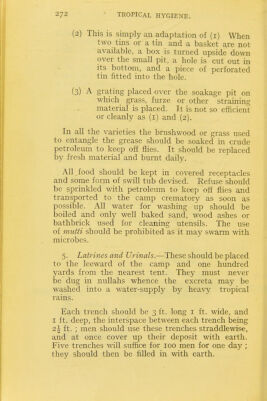
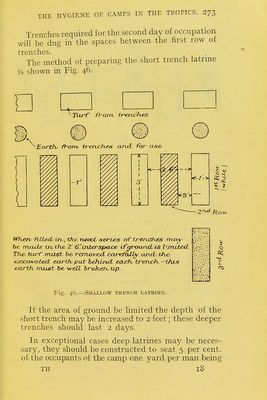
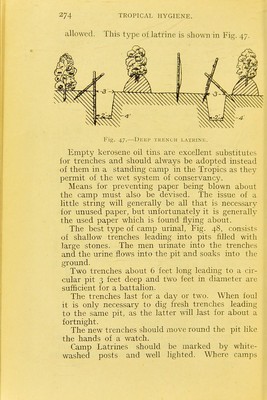
![watered from troughs where possible to avoid unnecessary fouhng of streams. The principles affecting water-supplies generally which have been laid down in Chapter IV apply of course, where practicable to camp supplies. A simple method of sterilizing any water which It might be dangerous to drink is as follows :— [a] Take a teaspoonful of bleaching powder (chloride of lime) (containing about h available chlorine) and remove the excess of powder by rolling a pencil, etc., along the top of the spoon. (6) Mix the bleaching powder in a cupful of water, making sure that all lumps are thoroughly broken up, and then add three more cupfuls of water to the solution. t,c) Stir up the mixture, allow it to stand for a few seconds to let any particles settle (this stock solution, if kept tightly stoppered, may be used for 4 or 5 days) and add one teaspoonful of this milky solution to 2 gallons of the water to be purified. Stir thoroughly and allow to stand for 10 minutes. This will give I part of free chlorine to a million parts of water, i lb. chloride is sufficient for 66,000 gallons. Note.—Bleaching powder (chloride of lime) deteriorates •rapidly when kept in cardboard packages or exposed to air. If a weak variety only is obtainable then, two teaspoonfuls of the solution should be added to 2 gallons of water. 4. Cooking Arrangements.— Camp kitchens should be situated [a] as far away as possible from the latrines, urinals and refuse receptacles, {b) to the windward of the camp, and (c) as near as possible to the water-supply. Kitchen waste water contains a large amomit of grease, and unless specially treated this substance](https://iiif.wellcomecollection.org/image/b21360224_0292.jp2/full/800%2C/0/default.jpg)