[Report 1935] / Medical Officer of Health, West Suffolk County Council.
- West Suffolk (England). County Council.
- Date:
- 1935
Licence: Attribution 4.0 International (CC BY 4.0)
Credit: [Report 1935] / Medical Officer of Health, West Suffolk County Council. Source: Wellcome Collection.
18/32 (page 16)
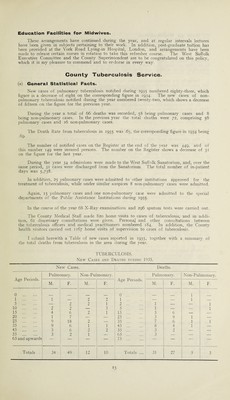
![(b) Note on Notifications. This year, as in 1934, the heaviest notifications of pulmonary tuberculosis in men is between the age periods of 25 and 45. In women, according to this year’s Table, the main notification figure is at the age period 25, when no fewer than eighteen of the forty-nine Dulmonary notifications were regis¬ tered The age periods 15 and 20 are about the same as last year, while there is a consid¬ erable drop in the notifications at the age period of 35. Generally the late notification rate for men in the middle forties is not so marked as last year, but the figure for women at the age period of 25 is a striking one. The total nodfications of pulmonary tuberculosis in both men and women show slight decreases on the figures for the previous year. In the non-pulmonary notifications the figure has declined fifty per cent, in males, and there is also a decrease in the figures for females. In 1935 there was a reduction in the total non-pulmonary cases from 37 to 22, which can be regarded as very satisfactory. (c) Note on Deaths during 1935. The pulmonary male and female deaths both show an increase of one on the figures of the previous year. The non-pulmonary deaths show in both males and females a decrease of four. In the female pulmonary table of deaths during the year it will be noticed that there is a heavy mortality between the age periods of 15 and 35 when no fewer than 21 deaths out of the total of 27 occurred. In the male pulmonary table of deaths the greatest mortality is in the age group 45, and this is followed closely by the age group 35. The distribution of these deaths is no new thing, but it shows very clearly how the disease of tuberculosis levies its toll at the most usefu] and promising periods of life. (d) Note on the County Sanatorium. There were certain alterations carried out at the Sanatorium during the year, including the provision of glass balconies in both the male and female wards, and this provision, apart from the marked improvement to the institution’s structure, enabled extra beds to be used. In addition, the institution was used continuously throughout the year, there being no serious closures for re-decoration. As a result, the number of patients treated in the institution was greater, and the total patient days increased by no fewer than 1659 days. The increased work involved by this extension in the activities was at times a heavy strain on the Staff, but the Matron and her Assistant Nurses came through a trying period in excellent fashion. In general, the Sanatorium has continued its three main functions: (1) to treat early cases, (2) to act as an observation and drafting centre for special cases which may be transferred elsewhere as occasion arises, and (3) to treat intermediate cases. I have to bring to your notice the work of the Matron and the Staff and I commend strongly their devoted and efficient service. (e) Note on the Service. The clinical service has been maintained unaltered, with domiciliary visiting as the main basis for its work. It is impossible, in view of transport and other similar difficulties, to maintain an efficient dispensary service, and such work is restricted to the Dispensary at Bury St. Edmund’s. Considerable and extended use has been made of X-Ray examinations, and these exam¬ inations increased from 51 in 1934 to' 68 in 1935. Sputum tests to the number of 296 were carried out in respect of erases in the area.](https://iiif.wellcomecollection.org/image/b30263578_0018.jp2/full/800%2C/0/default.jpg)