[Report 1935] / Medical Officer of Health, West Suffolk County Council.
- West Suffolk (England). County Council.
- Date:
- 1935
Licence: Attribution 4.0 International (CC BY 4.0)
Credit: [Report 1935] / Medical Officer of Health, West Suffolk County Council. Source: Wellcome Collection.
26/32 (page 24)
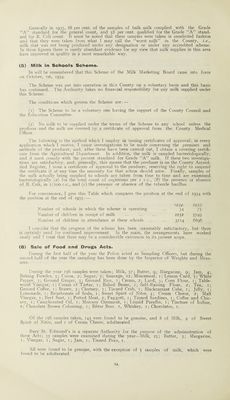
![Generally in 1935, 88 per cent, of the samples of bulk milk complied with the Grade “A” standard for the general count, and 58 per cent, qualified for the Grade “A” stand¬ ard for B. Coli count. It must be noted that these samples were taken in unselected fashion and that they were taken from what I may call the “worst mi]k” in the County, i.e., milk that was not being produced under any designation or under any accredited scheme. In these figures there is surely abundant evidence for my view that milk supplies in this area have improved in quality in a most remarkable way. (5) Milk in Schools Scheme. In will be remembered that this Scheme of the Milk Marketing Board came into force on October, 1st, 1934. The Scheme was put into operation in this County on a voluntary basis and this basis has continued. The Authority takes no financial responsibility for any milk supplied under this Scheme. The conditions which govern the Scheme are: — (1) The Scheme to be a voluntary one having the support of the County Council and the Education Committee. (2) No milk to be supplied under the terms of the Scheme to any school unless the producer and the milk are covered by a certificate of approval from the County Medical Officer. The following is the method which I employ in issuing certificates of approval; in every application which I receive, I cause investigations to be made concerning the premises and methods of the producer, and, after these have been carried out, I obtain a covering certifi¬ cate from the Agricultural Department. In addition, the milk is sampled bacteriologically, and it must comply with the present standard for Grade “A” milk. If these two investiga¬ tions are satisfactory, and, generally, this means that the producer is on the County Accred¬ ited Register, I issue a certificate of approval to the producer, reserving the right to suspend the certificate if at any time the necessity for that action should arise. Finally, samples of the milk actually being supplied to schools are taken from time to time and are examined bacteriologically (a) for the total count of organisms per 1 c.c., (b) the presence or absence of B. Coli, in 1/100 c.c., and (c) the presence or absence of the tubercle bacillus. For convenience, I give this Table which compares the position at the end of 1934 with the position at the end of 1935: — 1934- 1935- Number of schools in which the scheme is operating ... 34 75 Number of children in receipt of milk ... ... ... 2232 3749 Number of children in attendance at these schools ... ... 3714 6896 I consider that the progress of the scheme has been reasonably satisfactory, but there is certainly need for continued improvement. In the main, the arrangements have worked easily and I trust that there may be a considerable extension to its present scope. (6) Sale of Food and Drugs Acts. During the first half of the year the Police acted as Sampling Officers, but during the second half of the year the sampling has been done by the Inspector of Weights and Meas¬ ures. During the year 156 samples were taken; Milk, 57; Butter, 9; Margarine, 9; Jam, 4; Baking Powder, 5; Cocoa, 2; Sugar, 3; Sausage, 12; Mincemeat, 1; Lemon Curd, 3; White Pepper, 3; Ground Ginger, 3; Ground Rice, I; Cream, 2; Lard, 3; Corn Flour, 1; Table- wood Vinegar, 1; Cream of Tartar, 1; Baked Beans, 1; Self-Raising Flour, 2; Tea, 1; Ground Coffee, 1; Brawn, 3; Chutney, 1; Tinned Crab, 1; Blackcurrant Cube, 1; Jelly, 1; Lemonade, 1 ; Bicarbonate of Soda, 1; Sweet Spirit of Nitre, 4; Cream Cheese, 2; Malt Vinegar, 1 ; Beef Suet, 1 ; Potted Meat, 2; Faggott, 1 ; Tinned Sardines, 1 ; Coffee and Chic¬ ory, 1 ; Camphorated Oil, 1 ; Mercury Ointment, 1 ; Liquid Paraffin, 1 ; Tincture of Iodine, 2; Chocolate Brown Colouring, 1; Bitter Beer. I, Whiskey, 1; Chocolates, 1. Of the 156 samples taken, 143 were found to be genuine, and 8 of Milk, 4 of Sweet Spirit of Nitre, and 1 of Cream Cheese, adulterated. Bury St. Edmund’s is a separate Authority for the purpose of the administration of these Acts; 33 samples were examined during the year—Milk, 25; Butter, 3; Margarine, 1; Vinegar, 1; Sugar, I; Jam, I; Tinned Peas, 1. All were found to be genuine, with the exception of 5 samples of milk, which were found to be adulterated.](https://iiif.wellcomecollection.org/image/b30263578_0026.jp2/full/800%2C/0/default.jpg)