Report of the Royal Commission on the Poor Laws and Relief of Distress. : Appendix Volume XIX. Report by Mr. Cyril Jackson and Rev. J.C. Pringle on the effects of employment or assistance given to the "unemployed" since 1886 as a means of relieving distress outside the Poor Law.
- Royal Commission on the Poor Laws and Relief of Distress 1905-09
- Date:
- 1909
Licence: In copyright
Credit: Report of the Royal Commission on the Poor Laws and Relief of Distress. : Appendix Volume XIX. Report by Mr. Cyril Jackson and Rev. J.C. Pringle on the effects of employment or assistance given to the "unemployed" since 1886 as a means of relieving distress outside the Poor Law. Source: Wellcome Collection.
Provider: This material has been provided by London School of Hygiene & Tropical Medicine Library & Archives Service. The original may be consulted at London School of Hygiene & Tropical Medicine Library & Archives Service.
10/872
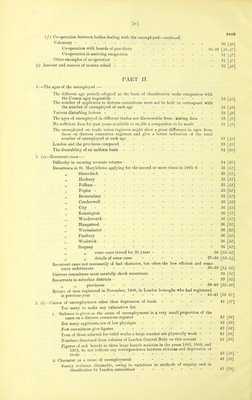
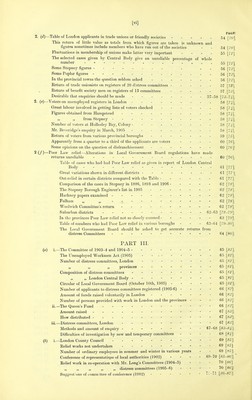
![(/) Co-operation between bodies dealing with the unemployed—caniinued. Voluntary 30 [^gj Co-operation with boards of guardians - . 30-31 [46-^7~\ Co-operation in assisting emigration 31 [^^7j Other examples of co-operation - 31 [^^7j (e) Amount and sources of monies raised ' 32 [^<?] PART II. 1. —The ages of the unemployed The different age periods adopted as the basis of classification make comparison with the Census ages impossible 33 [^p] The number of applicants to distress committees must not be held to correspond with the number of unemployed of each age - 33 [^9] Various disturbing factors 33 [^9] The ages of unemployed in different trades not discoverable from (xisting data - - 33 [49J No sufficient data for past years available to enable a comparison to be made - - 33 [49] The unemployed on trade union registers might show a great difference in ages from those on distress committee registers and give a better indication of the total number of unemployed at each age 33 [49J London and the provinces compared 33 [49J The desirability of an uniform basis 34 [50J 2. (a)—Recurrent cases :— Difficulty in securing accurate returns - - - 34 Recurrents in St. Marylebone applying for the second or more times in 1905-6 - - 35 [51] Shoreditch 35 [51] Hackney ----- 35 [5^] Fulham - - - - - 35 [5l\ Poplar 35 [51} „ Bermondsey 35 [51} Camberwell 36 [53] City ------------- 36 [5^] „ Kensington - - - - 36 [5^] Wandsworth -------- - - 36 [53] ,, Hampstead - - 36 [52] Westminster ------ 36 [53] Finsbury ----- 36 [53] Woolwich ------------ dQ [53] Stepney 36 [5^] „ some cases traced for 20 years 36 [53-53] „ details of some cases 37-38 [53-54] Recurrent cases not necessarily of bad character, but often the less efficient and some- times unfortunate 38-39 [54-55] Distress committees must carefully check recurrents - 39 [55] Recurrents in suburban districts 39 [55] provinces 39-40 [55-56] Return of men registered in November, 1906, in London boroughs who had registered in previous year 40-41 [56-57] 2. Causes of unemployment other than depression of trade 41 [57] Too many to make any exhaustive list. i. Sickness is given as the cause of unemployment in a very small proportion of the cases on a distress committee register 42 [68] But many applicants are of low physique 42 [58] Few committees give figures 42 [58] Even of those selected for relief works a large number are physically weak - - 42 [58] Numbers dismissed from colonies of London Central Body on this account - - 42 [58] Figures of sick benefit in three large benefit societies in the years 1893, 1900, and 1903 do not indicate any correspondence between sickness and depression of trade ■ ^3 [59] - ii. Character as a cause of unemployment 43 [59] Scanty evidence obtainable, owing to variations in methods of enquiry and in classification by London committees - - - ' - - - - 43 [59]](https://iiif.wellcomecollection.org/image/b24399991_0010.jp2/full/800%2C/0/default.jpg)