Report of the Royal Commission on the Poor Laws and Relief of Distress. : Appendix Volume XIX. Report by Mr. Cyril Jackson and Rev. J.C. Pringle on the effects of employment or assistance given to the "unemployed" since 1886 as a means of relieving distress outside the Poor Law.
- Royal Commission on the Poor Laws and Relief of Distress 1905-09
- Date:
- 1909
Licence: In copyright
Credit: Report of the Royal Commission on the Poor Laws and Relief of Distress. : Appendix Volume XIX. Report by Mr. Cyril Jackson and Rev. J.C. Pringle on the effects of employment or assistance given to the "unemployed" since 1886 as a means of relieving distress outside the Poor Law. Source: Wellcome Collection.
Provider: This material has been provided by London School of Hygiene & Tropical Medicine Library & Archives Service. The original may be consulted at London School of Hygiene & Tropical Medicine Library & Archives Service.
11/872
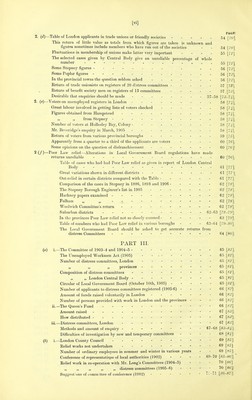
![PAGE 2. (J]—Causes of unemployment, etc.—continued. ii. Character as a cause of unemployment—conlinu.d. Importance of genuine investigation in the interests of the unemployed themselves Employers apt to give good references to give a man a chance of relief - 43 [-59J Probably the number of applicants unemployed through their own misconduct is under 15 per cent On the other hand a large number of applicants object to regular hard work, as shewn by men leaving relief works after a few days 44 {60] Single men frequently discharged for minor faults 44 [60] Number discharged from the colony works as unsatisfactory .... 44 [60] A few figures from suburban districts 44-45 \60-61] The same unreadiness in the provincial towns to classify by character - - - 45 [67] Figures from various towns from 1 per cent, to 15 per cent. .... 45 \61] The opinion of the conference of the London County Council (1903) - - 45-46 \61-62] Deterioration of character when work casual 46 \62] iii. The casual nature of employment in many trades the main cause of the numbt-r of ' unemployed' - - - 46 [62] Casual labour rendered possible by the earnings of wives and children - - 46-47 [62-63] iv. Seasonal character of certain trades 47 [63] The building trades still much depressed 47 [6S] The questions connected with employment in these trades and the organisation of labour too large to be dealt with here 47 [63] V. Over specialisation in certain industries 47 [63] Desirability of amalgamation or federation of some trade unions - - - 47 [63] vi. Introduction of machinery seldom given by applicants as cause of unemployment in London 47 [63] Unskilled machine minders take the place of skilled mechanics - - - 48 [64] The boot and shoe trades in the provinces 48 [6^] Metal trades In Sheffield and Birmingham 48 [64] vii. The decay of apprenticeship 48 [64] viii. Boy labour which leads to no permanent employment 48 [64] The large number of errand boys in London 48 [64] Compared with the provinces 48-49 [64.-60] Newsboys and street selling 49 [60] The Government as employer of boy labour 49 [65] ix. Army service unfits men for regular work 49 [65] Numbers of army men on distress registers 50 [66] Army service does not train men to habits of industry 50 [66] X. Alien immigration occasionally given as a reason for unemployment - - - 50 [66] Little evidence obtainable of the displacement of labour by aliens - - - 50 [66] xi. In some cases relief works have been responsible for regular employees losing their work 51 [67] xii. In the firewood trade independent men have been ousted by charity or rate-aided competition. Some cases in London ........ 51 [67] Return of the Trade Association shows great reduction of independent labour - 52 [68] The defence of the Church Army 52 [68] Charitable societies can very seriously harm an industry 52 [68] 2. (c)—Relative number of artisans and labourers - 53 [69] The terms themselves not easily defined - - .... - 53 [69] The bulk of the applicants labourers 53 [69] The building trades most depressed at present 53 [69] The number of unemployed in a trade cannot be obtained from distress committee registers alone 53 [69] The skilled men would be more largely in the trade unions 53 [69] Such returns as are available from distress committees indicate that less than 20 per cent, are skilled 53 [69] The basis of the returns not uniform, so the return unreliable 53 [69] Provincial towns 53 [69] Are the skilled men who apply the less satisfactory ? - ' 54 [70] The skilled men better able to get through a period of unemployment without applying for relief 54 [70] 429—B. A 2](https://iiif.wellcomecollection.org/image/b24399991_0011.jp2/full/800%2C/0/default.jpg)

 No text description is available for this image
 No text description is available for this image
 No text description is available for this image