Report of the Royal Commission on the Poor Laws and Relief of Distress. : Appendix Volume XIX. Report by Mr. Cyril Jackson and Rev. J.C. Pringle on the effects of employment or assistance given to the "unemployed" since 1886 as a means of relieving distress outside the Poor Law.
- Royal Commission on the Poor Laws and Relief of Distress 1905-09
- Date:
- 1909
Licence: In copyright
Credit: Report of the Royal Commission on the Poor Laws and Relief of Distress. : Appendix Volume XIX. Report by Mr. Cyril Jackson and Rev. J.C. Pringle on the effects of employment or assistance given to the "unemployed" since 1886 as a means of relieving distress outside the Poor Law. Source: Wellcome Collection.
Provider: This material has been provided by London School of Hygiene & Tropical Medicine Library & Archives Service. The original may be consulted at London School of Hygiene & Tropical Medicine Library & Archives Service.
17/872
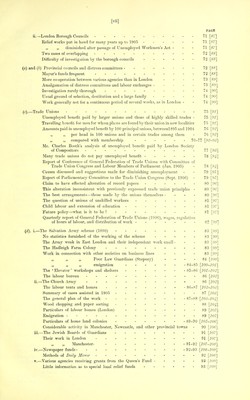
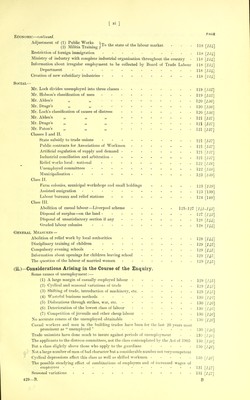
![[ ] ^ , PAGE ECONOMIC—conhnued. Adjustment of (1) Public Works ^n^ ^ ^ c , , , , (2) Militia Training 1^*'*^®'*^'^*^^'^^^ ^'^^^^^^rk^^ ' US Eestriction of foreign immigration [iJ^] Ministry of industry with complete industrial organization throughout the country - 118 [lo^.] Information about irregular employment to be collected by Board of Trade Labour 118 [1^4] Department 118 [ij^] Creation of new subsidiary industries 118 [7J^] Social— Mr. Loch divddes unemployed into three classes 119 [7JJ] Mr. Hobson's classification of men - - 119 [iJ,5] Mr. Alden's „ „ 120 [136] Mr. Drage's „ „ 120 [136] Mr. Loch's classification of causes of distress - - 120 [136] Mr. Alden's „ „ „ 121 [i3j] Mr. Drage's „ „ „ - 121 [757] Mr. Paton's „ „ „ 121 [^,57] Classes I and IL State subsidy to trade unions 121 [137] Public contracts for Associations of Workmen 121 [137] Artificial regulation of supply and demand - - - - - . . -121 [1-37] Industrial conciliation and arbitration 121 [137] Eelief works local : national 122 [138] Unemployed committees 122 [138] Municipalisation I23 [139] Class IT. Farm colonies, municipal workshops and small holdings • - - . -12.3 [139] Assisted emigration 123[139] Labour bureaux and relief stations - - - - - - - . -124 [140] Class III. Abolition of casual labour—Liverpool scheme 125-127 [14I-I43] Disposal of surplus—on the land - - - - - - - . . -127 [143] Disposal of unsatisfactory section if any 128 [I44.] Graded labour colonies 128 [I44] General Measures— Abolition of relief work by local authorities 128 [I44] Disciplinary training of children 129 [I45] Compulsory evening schools - 129 [145] Information about openings for children leaving school 129 [I40] The question of the labour of married women 129 [145] (ii.)—Considerations Arising in the Course of the Enquiry. Some causes of unemployment:— (1) A large margin of casually employed labour 129 [I45] (2) Cyclical and seasonal variations of trade - - - - - - - 129 [145] (3) Shifting of trade, introduction of machinery, etc. 129 [I45] (4) Wasteful business methods 13Q [146] (5) Dislocations through strikes, war, etc. 130 [I46] (6) Deterioration of the lowest class of labour 130 [I46] (7) Competition of juvenile and other cheap labour 130 [I46] No accurate census of the unemployed obtainable - - 130 [146] Casual workers and men in the building trades have been for tlie last 20 years most prominent as unemployed - - - - 130 [146] Trade unionists have done much to insure against periods of unemployment - - 130 [I4U] The applicants to the distress committees, not the class contemplated In- the Act of 1905 130 [146] But a class slightly above those who apply to the guardians - - - - - 130 [I46] Not a large number of-men of bad character but a considerable number not ver}^competent Cyclical depressions affect this class as well as skilled workmen 130 [I46] The possible steadying effect of combinations of employers and of increased wages of employees 131 [147] Seasonal variations 131 [/^7] 429—B. B](https://iiif.wellcomecollection.org/image/b24399991_0017.jp2/full/800%2C/0/default.jpg)

 No text description is available for this image
 No text description is available for this image
 No text description is available for this image