Report of the Royal Commission on the Poor Laws and Relief of Distress. : Appendix Volume XIX. Report by Mr. Cyril Jackson and Rev. J.C. Pringle on the effects of employment or assistance given to the "unemployed" since 1886 as a means of relieving distress outside the Poor Law.
- Royal Commission on the Poor Laws and Relief of Distress 1905-09
- Date:
- 1909
Licence: In copyright
Credit: Report of the Royal Commission on the Poor Laws and Relief of Distress. : Appendix Volume XIX. Report by Mr. Cyril Jackson and Rev. J.C. Pringle on the effects of employment or assistance given to the "unemployed" since 1886 as a means of relieving distress outside the Poor Law. Source: Wellcome Collection.
Provider: This material has been provided by London School of Hygiene & Tropical Medicine Library & Archives Service. The original may be consulted at London School of Hygiene & Tropical Medicine Library & Archives Service.
46/872 page 22
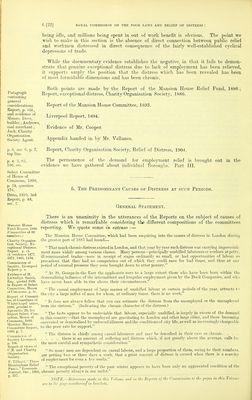
![being idle, and millions being spent in out of work benefit is obvious. The point we wish to make in this section is the absence of direct connection between public relief and workmen distressed in direct consequence of the fairly well-established cyclical depressons of trade. While the documentary evidence establishes the negative, in that it fails to demon- strate that genuine exceptional distress due to lack of employment has been relieved, it supports amply the position that the distress which has been revealed has been of most formidable dimensions and has been chronic. Paragraph containing general considerations. Report, p. viii., and evidence of Messrs. Dove, builder; Andrews, coal merchant; Jack, Charity Organisation Society Agent. p. 6, sec. 6, p. 7, top line. p. X. 2, 82, 106, etc. Select Committee of House of Commons, 1896, p. 24, question 476. Ditto, 189.5, 3rd Report, p. 48, sec. 2. Both points are made by the Report of the Mansion House Relief Fund, 1886 ; Report, exceptional distress, Charity Organisation Society, 1886, Report of the Mansion House Committee, 1893. Liverpool Report, 1894. Evidence of Mr. Cooper. Appendix handed in by Mr. Vallance. Report, Charity Organisation Society, Relief of Distress, 1904. The permanence of the demand for employment relief is brought out in the evidence we have gathered about individual Boroughs. Part III. 6. The Predominant Causes of Distress at such Periods. General Statement. Mttiisioi] House Fund Report, 1886 (Coiinnittee of 69 members.) Charity Organisa- tion Society, Ex- ceptional Distress. Report p. vi. cf. evidence 1477, 2471, 1468, 1134. Commission of Imjuiry, Liverpool. Report p. X. Evidence of H. Llewellj'n Smith, Esq., quoted 1896 in Report of Select Committee, House of Cotiinious, p. iv. Report of Commit- tee of (hiardiaiis of Wliitechapel union, 1S88, printed in Appendix 29, 8ra Report Select Com- :nittee, House of Commons, 1895. Mansion House Conunittee Report, 1893, p. 7. (.'onimission of Inquiry Liverpool, p. 106.' Report of views of C.R. and Cliarity Organisation Society. F. TilUard, Throe Birmingham Relief Fnuds, Economic Journal, Dec, 1905, p. 517. There is an unanimity in the utterances of the Reports on the subject of causes of distress which is remarkable considering th<e different compositions of the committees- reporting. We quote some in extenso :— The Mansion House Committee, which had been enquiring into the causes of distress in London during the greater part of 1885 had found— That much chronic distress existed in London, and that year by year such distress was carrying impoverish- ment more widely among various classes. Many persons—principally unskilled labourers or workers at petty, ill-remunerated trades—were in receipt of wages ordinarily so small, or had opportunities of labour so precarious that they had no competence out of which they could save for bad times, and thus at any period of unusual pressure they were brought down to utter penury. At St. George-in-the East the applicants were to a large extent those who have been born within the demoralising influence of the intermittent and irregular employment given by the Dock Companies, and who have never been able to rise above their circumstances. The casual employment of large masses of unskilled labour at certain periods of the year, attracts tn the city a large influx of men for whom, at ordinary times, there is no work. '■ It does not always follow that you can estimate the distress from the unemployed or the unemployed from tlie distress. (Indicating the chronic character of the distress.) The facts appear to be undeniable that labour, especially unskilled, is largely in excess of the demand in this country—that the unemployed are gravitating to London and other large cities, and there becoming enervated or demaralised by enforced idleness and the conditions of city life, asweU as increasingly chargeable to the poor rate for support. The distress is chiefly among casual labourers and mav be described in their case as chronic. . . . . . . . there is an amount of suffering and distress which, if not greatly above the average, calls for the most careful and sympathetic consideration So many men are dependent on casual labour, and a large proportion of them, owing to their numbers, are getting two or three days a week, that a great amount of distress is caused when there is a scarcity of employment for even a few weeks. The exceptional poverty of the past wnter appears to have been only an aggravated condition of the cbronic poverty always in our midst.'' NOTE—References made in this Volume and in the Beports of the Commission to the pages in this Volume](https://iiif.wellcomecollection.org/image/b24399991_0046.jp2/full/800%2C/0/default.jpg)
 No text description is available for this image
 No text description is available for this image
 No text description is available for this image