A dictionary of terms used in medicine and the collateral sciences / by the late Richard D. Hoblyn.
- Richard Hoblyn
- Date:
- 1892
Licence: Public Domain Mark
Credit: A dictionary of terms used in medicine and the collateral sciences / by the late Richard D. Hoblyn. Source: Wellcome Collection.
Provider: This material has been provided by University of Bristol Library. The original may be consulted at University of Bristol Library.
65/842 page 53
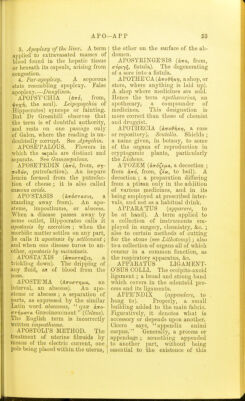
![3. Apoplexy of the liver. A term applied to extravasated masses of blood found in the hepatic tissue or beneath its capsule, arising from congestion. 4. Par-apoplexy. A soporous state resembling apoplexy. False apoplexy. —D unglison. APOPSY'CHIA (dTrJ, from, ^vxh, the soul). Leip)opsychia of Hippocrates) syncope or fainting. But Dr Greenhill observes that the term is of doubtful authority, and rests on one passage only of Galen, where the reading is un- doubtedly corrupt. See Apsychia. APOSE'PALOUS. Flowers in which the sepals are distinct and separate. See Gamosepalous. APOSE'PEDIN (drrJ, from, ari- ireSoi;', putrefaction). An impure leucin formed from the putrefac- tion of cheese; it is also called caseous oxide. APO'STASIS {hTr6<rra(ns, a standing away from). An apo- steme, imposthume, or abscess. When a disease passes away by some outlet, Hippocrates calls it apostasis by excretion; when the morbific matter settles on any part, he calls it apostasis by settlement; and when one disease turns to an- other, aj)ostasis by metastasis. APOSTA'XIS (aTToo-Tolfs, a tiickliiig down). The dripping of any fluid, as of blood from the nose. APOSTE'MA (dTToo-TrjMa, an interval, an abscess). An apo- steme or abscess ; a separation of ■])arts, as expressed by the similar Latin word abscessus, quae airo- arr\naja Grajcinominant (Gelsus). The English term is incorrectly written impusthume. APOSTOLI'S METHOD. The treatment of uterine fibroids by means of the electric current, one pole being placed within the uterus, | the other on the surface of the ab- domen. APOSYRINGE'SIS (^tto, from, ffvpiy^, fistula.). The degenerating of a sore into a fistula. APOTHE'CA [d-TToeiiKri, a shop, or store, Avhere anything is laid up). A shop where medicines are sold. Hence the term ajwthccarius, an apothecary, a compounder of medicines. This designation is more correct than those of chemist and druggist. APOTHEGIA {6.TToei)Kii, a case or repository). Scutella. Shields ; a name given, in botany, to some of the organs of reproduction in cryptogamic plants, particularly the Lichens. A'POZEM (aTr({^€;uo, a decoction ; from 0.1:6, from, fe'co, to boil). A decoction ; a preparation did'ering from a ptisan only in the addition of various juedicines, and in its being employed at prescribed inter- vals, and not as a habitual drink. APPARA'TUS {apparere, to be at hand). A term applied to a collection of instruments em- ployed in surgery, chemistry, &c. ; also to certain methods of cutting for the stone (see Lithotomy); also to a collection of organs all of which concur in a common function, as the respiratory apparatus, &c. APPARATUS LIGAMENT- O'SUS COLLI. The occipito-axoid ligament ; a broad and strong band which covers in the odontoid pro- cess and its ligaments. APPE'NDIX {appendere, to hang to). Properly, a small building added to the main fabric. Figuratively, it denotes what is accessory or depends upon another. Cicero says, appendix auimi corpus. Generally, a process or appendage ; something appended to another part, without being essential to the existence of this](https://iiif.wellcomecollection.org/image/b21442988_0065.jp2/full/800%2C/0/default.jpg)
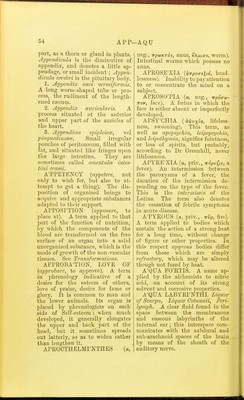
 No text description is available for this image
 No text description is available for this image
 No text description is available for this image