Volume 1
The physiological anatomy and physiology of man / by Robert Bentley Todd and William Bowman.
- Date:
- 1845-1856
Licence: Public Domain Mark
Credit: The physiological anatomy and physiology of man / by Robert Bentley Todd and William Bowman. Source: Wellcome Collection.
Provider: This material has been provided by the Royal College of Physicians of Edinburgh. The original may be consulted at the Royal College of Physicians of Edinburgh.
432/476
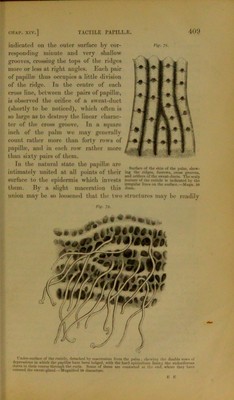
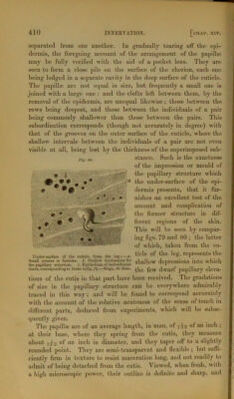
![Fig. 80. separated from one another. In gradually tearing off the epi- dermis, the foregoing account of the arrangement of the papillae may be fully verified with the aid of a pocket lens. They are seen to form a close pile on the surface of the chorion, each one being lodged in a separate cavity in the deep surface of the cuticle. The papillae arc not equal in size, hut frequently a small one is joined with a large one : and the clefts left between them, by the removal of the epidermis, are unequal likewise; those between the rows being deepest, and those between the individuals of a pair being commonly shallower than those between the pairs. This subordination corresponds (though not accurately in degree) with that of the grooves on the outer surface of the cuticle, where the shallow intervals between the individuals of a pair are not even visible at all, being lost by the thickness of the superimposed sub- stance. Such is the exactness of the impression or mould of • i the papillary structure which “ ia the under-surface of the epi- dermis presents, that it fur- nishes an excellent test of the amount and complication of the former structure in dif- ferent regions of the skin. This will be seen by compar- ing figs. 79 and 80 ; the latter of which, taken from the cu- Under-surfoce of the cuticle, from the Ie?:-«. ticle °f tlie leg, represents the Small creases or furrows. A. Shallow depressions for g}la]]ow depressions illto which the papillary structure, c. Epithelium of sudoriferous I ducts, corresponding to those in fig. 79-—Magn. 30 diam. £jjg few dwarf papillary eleva- tions of the cutis in that part have been received. The gradations of size in the papillary structure can be everywhere admirably traced in this way; and will be found to correspond accurately with the account of the relative acuteness of the sense of touch in different parts, deduced from experiments, which will be subse- quently given. The papillae are of an average length, in man, of 7-^5- of an inch; at their base, where they spring from the cutis, they measure about tis °f an inch l11 diameter, and they taper off to a slightly rounded point. They are semi-transparent and flexible ; but suffi- ciently firm in texture to resist maceration long, and not readily to admit of being detached from the cutis. Viewed, when fresh, with a high microscopic power, their outline is definite and sharp, and](https://iiif.wellcomecollection.org/image/b28043327_0001_0432.jp2/full/800%2C/0/default.jpg)