Volume 1
The physiological anatomy and physiology of man / by Robert Bentley Todd and William Bowman.
- Date:
- 1845-1856
Licence: Public Domain Mark
Credit: The physiological anatomy and physiology of man / by Robert Bentley Todd and William Bowman. Source: Wellcome Collection.
Provider: This material has been provided by the Royal College of Physicians of Edinburgh. The original may be consulted at the Royal College of Physicians of Edinburgh.
441/476
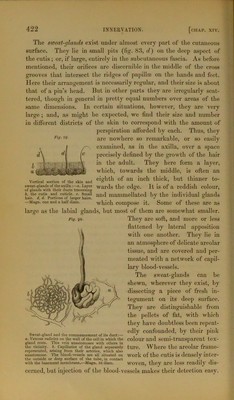
![STRUCTURE OF HAIR. r>g. as. CHAP. XIV.] gradually to mount on the hair, be- coming more compressed against it in their ascent, until they form upon its surface a thin transparent colour- less film, in which the overlapping of the delicate cells is still exhibited by elegant and exceedingly fine sinuous cross lines (fig. 88, d, d'). The fibrous interior and this peculiar cortex to- gether compose the shaft of the hair. By the continual emergence of fresh |H)rtions of the shaft from the follicle, fragments of the cuticuiar lining of the latter are apt to be drawn up upon the hair, aided, probably, in this, by the imbrication of its surface, and are often found clinging around it tor some way ; but they are not to be regarded as any part of the hair itself. £*£ In the larger hairs there is usually a double series of these imbricated cortical scales; the outer having its teeth iuterlocked with those of the inner, but apparently but loosely adherent to them. This outer series seems to be intermediate be- tween the true cortex and the cuticle of the follicle, and to belong rather to the latter, since it does not appear upon the extended portion of the hair. The cortex is much denser than even the fibrous j«irt of the hair, and is less acted upon by strong solution of potass. From the preceding description it will be evident that the fibrous part of the hair is a peculiar developoment of the cuticuiar cells resting on the bottom of the follicle, that the imbricated cortex is formed by a single series differently developed at the circumference of these, and that beyond this series comes the cuticuiar lining of the follicle ; so that the hair is neither covered nor underlaid by cuticle, but it is in fact the modified cut icle of the bottom of the follicle. A thin layer of papillary tissue probably coats the bottom of the follicle in most cases; ami where the hairs are large, and especially where they serve principally as tactile organs, there may be a projection of a true papilla, furnished with nerves and capillaries, into the bulb of the hair, as is very conspicuous in the whiskers of some animals and C / r Trtuiitme section of a hair of the head, shewing the exterior cortex, the fibrous tissue pigment section. without a central cavity, shewing the imbrication of the cortex, and the ar- rangement of the pigment in the fibrous part. d. Surface, shewing the sinuous transverse lines formed by the edges of the cortical scale*, d'. A portion of the margin, shew- ing their imbrication Magn. 150 diain.](https://iiif.wellcomecollection.org/image/b28043327_0001_0441.jp2/full/800%2C/0/default.jpg)