Volume 1
The physiological anatomy and physiology of man / by Robert Bentley Todd and William Bowman.
- Date:
- 1845-1856
Licence: Public Domain Mark
Credit: The physiological anatomy and physiology of man / by Robert Bentley Todd and William Bowman. Source: Wellcome Collection.
Provider: This material has been provided by the Royal College of Physicians of Edinburgh. The original may be consulted at the Royal College of Physicians of Edinburgh.
447/476
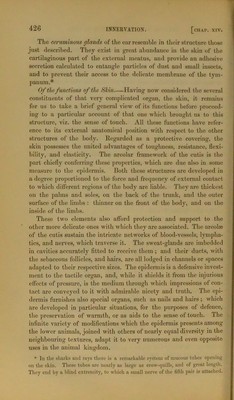
![chap, xiv.] ENTOZOA OF THE SEBACEOUS GLANDS. in most parts of the skin, but are absent from the palms and soles. They are most abundant on the scalp and face (especially about the nose), and about the anus and scrotum. The plandula odorifertt of the genital organs are a variety of them, only remarkable by their secretion. The orifices open either on the general surface, or into the hair-follicles, and they lie either in the cutis or sub- dermoid tissue, according to their size. They are usually asso- ciated with the hairs, in the manner represented in fig. 92. They consist of a more or less capacious duct, generally branched, and terminating in blind, pouch-like extremities. The basement mem- brane of these glands is thicker thnn that of the sweat-glands, and is lined by an epithelium, in the particles of which are in- cluded granules of sebaceous matter. The terminal vesicles and the ducts are filled with an accumulation of this epithelium, which, having been detached from the walls, constitutes the secretion. On the deep or parenchymal surface of the basement membrane a web of capillary vessels is spread out. While speaking of the sebaceous glands, we must say a few words of a parasite so generally found in their ducts in many parts of the body, that it may almost be regarded as a denizen. This was recently discovered by Dr. Simon of Berlin,* and has been further describ- ed by Mr. Wilson,-f* who speaks of two principal varieties of the adult ani- mal, chiefly distinguished by their length ; the one measuring from T,(0 to A> the other from ~ to tAar of an inch. He de- tails several interesting particulars concerning their structure and de- velopment, for which we must refer to the original memoir. These singular animals uai e found in al- from the sebaceous follicles -.—a. Two seen in their . , , ordinary position in the orifice of one of the sebaceous follicles most every individual, and of tl“' *call>' *• Short variety. c. Ixmg variety, especially in those possessing a torpid skin, and they multiply in sickness. In living and healthy persons from one to three or four may bo found in each follicle.” We have represented them as we have found them in a sebaceous follicle of the scalp (fig. 93). * M filler's Archiv., June, lb42. + Phil. Transact. 1844.](https://iiif.wellcomecollection.org/image/b28043327_0001_0447.jp2/full/800%2C/0/default.jpg)