Heredity / by J. Arthur Thomson.
- Thomson, J. Arthur (John Arthur), Sir, 1861-1933.
- Date:
- 1908
Licence: In copyright
Credit: Heredity / by J. Arthur Thomson. Source: Wellcome Collection.
Provider: This material has been provided by King’s College London. The original may be consulted at King’s College London.
49/668 (page 29)
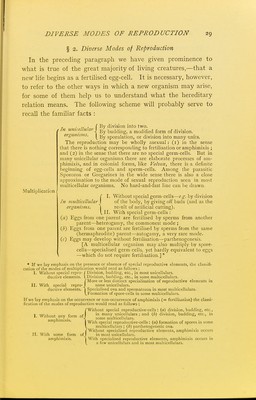
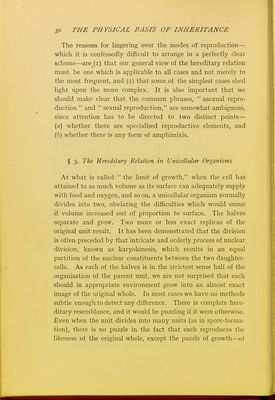
![§ 2. Diverse Modes of Reproduction In the preceding paragraph we have given prominence to what is true of the great majority of living creatures,—that a new Hfe begins as a fertilised egg-cell. It is necessary, however, to refer to the other ways in which a new organism may arise, for some of them help us to understand what the hereditary relation means. The following scheme will probably serve to recaU the familiar facts : Multiplication ( By division into two. } Bv /« itmMar, budding, a modified form of division.^ orgamstns. y sporulation, or division into many units. The reproduction may be wholly asexual : (i) in the sense that there is nothing corresponding to fertilisation or amphimixis ; and (2) in the sense that there are no special germ-cells. But in many unicellular organisms there are elaborate processes of am- phimixis, and in colonial forms, like Volvox, there is a definite lieginning of egg-cells and sperm-cells. Among the parasitic Sporozoa or Gregarines in the wide sense there is also a close approximation to the mode of sexual reproduction seen in most multicellular organisms. No hard-and-fast line can be drawn. ( I. Without special germ-cells—e.^. by division In DiuUicelhdar ) of the body, by giving off buds (and as the organisms. \ result of artificial cutting). I. II. With special germ-cells : (a) Eggs from one parent are fertilised by sperms from another parent—heterogamy, the commonest mode ; {b) Eggs from one parent are fertilised by sperms from the same (hermaphrodite) parent—autogamy, a very rare mode. (0 Eggs may develop without fertilisation—parthenogenesis. [A multicellular organism may also multiply by spore- cells—specialised germ-cellsj yet hardly equivalent to eggs —which do not require fertilisation.] * ♦ If we lay emphasis on the presence or absence of special reproductive elements, the classifi- cation of the modes of multiplication would read as follows : I. Without special repro- / Division, budding, etc., in most unicellulars, II. ductive elements. With speci.il repro- ductive elements. { ivision, budding, etc., in some multicellulars. More or less distinct speci.ilisation of reproductive elements in some unicellulars. Specialised ova and spermatozoa in most multicellulars. Formation of spore-cells in some multicellulars. If we lay emphasis on the occurrence or non-occurrence of amphimi-xis (= fertilisation) the classi- fication of the modes of reproduction would read as follows : Without special reproductive-cells: (a) division, budding, etc., in many unicellulars ; and (6) division, budding, etc., in some multicellulars. With special reproductive-cells : (a) formation of spores in some multicellulars ; (6) parlhenogenetic ova. 'Without specialised reproductive elements, amphimi.xis occurs in most unicellulars. With specialised reproductive elements, amphimixis occurs in a few unicelluLirs and in most multicellulars. I. Without any form of_ amphimixis. 11. With some form amphimixis. of](https://iiif.wellcomecollection.org/image/b2129589x_0049.jp2/full/800%2C/0/default.jpg)