Heredity / by J. Arthur Thomson.
- Thomson, J. Arthur (John Arthur), Sir, 1861-1933.
- Date:
- 1908
Licence: In copyright
Credit: Heredity / by J. Arthur Thomson. Source: Wellcome Collection.
Provider: This material has been provided by King’s College London. The original may be consulted at King’s College London.
68/668 (page 46)
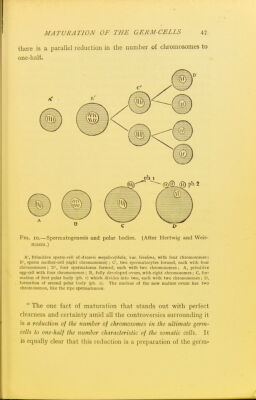
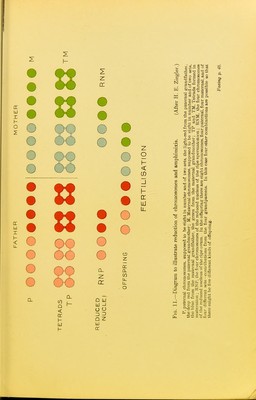
![pig, and in man * the number is said to be i6, and the same number is characteristic of the onion. In the grasshopper it is 12 ; in the hepatic Pallavicinia and some of the nematodes, 8 ; and in Ascaris, another thread-worm, 4 or 2. In the crustacean Artemia it is 168. Under certain circumstances, it is true, the number of chromosomes may be less than the normal in a given species; but these variations are only apparent exceptions [p. 87, Wilson]. The even number of chromosomes is a most interesting fact, which, as will appear hereafter [p. 205, Wilson], is due to the derivation of one-half the number from each of the parents. 2. About 1883, Van Beneden made the important discovery that the nuclei of the ovum and of the spermatozoon which unite in fertilisation contain each one-half of the number of chromosomes characteristic of the body-cells. This has been confirmed in regard to so many plants and animals that it may now be regarded as a general fact. The student should refer to the partial list given by Wilson (1900, pp. 206-7), where it wiU be seen that if the somatic nuclei have 12, 16, 18, or 24 chromosomes, the germ-nuclei have 6, 8, 9, or 12 respectively. A striking case is found in the large thread-worm [Ascaris megalo- cephala) of the horse, which occurs in two varieties,—the one, var. univalens, with two chromosomes in its body-cells has one chromosome in its germ-nuclei; the other, var. bivalens, with four chromosomes in its body-cells, has two chromosomes in its germ-nuclei. 3. If each of the nuclei which unite in fertilisation has only half as many chromosomes as are characteristic of the species, it follows that a reduction of the number must take place in the history of the germ-cells, and this is the outstanding fact in the process of maturation. Alike in the history of the egg (oogenesis) and in the history of the sperm (spermatogenesis), * Flemming believed the number in man to be considerably greater than 16. It is now generally stated to be 24.](https://iiif.wellcomecollection.org/image/b2129589x_0068.jp2/full/800%2C/0/default.jpg)